“With our love, we could save the world, if they only knew,” George Harrison declared on ‘Within You, Without You’, one of his definitive The Beatles tunes from Sgt Pepper’s Lonely Hearts Club Band that summarised much of what the 1960s’ counterculture was attempting to communicate: a universal love and peace, and a removal of personal ego in favour of community and transcendence.
Harrison was the first Beatle to show interest in Indian culture and Hinduism, having visited India in the fall of 1966. His love for Indian classical music began in childhood, a love that poured into his music from the sitars used on ‘Norwegian Wood (This Bird Has Flown)’ from Rubber Soul to the sitar and tabla played on ‘Love You To’ from Revolver.
Around the time he first visited India, he was beginning to feel disillusioned with The Beatles, his exposure to Eastern philosophies, gurus and religious leaders sparking a shift in his way of thinking: surely, something lay beyond the whirlwind of Beatlemania, the uniformity of the music industry, and his and his bandmates’ incessant drug-taking (LSD, namely), in search of enlightenment. Thanks to a newspaper advertisement seen by his wife, Pattie Boyd, promoting classes on transcendental meditation, Harrison thought he may have found his answer.
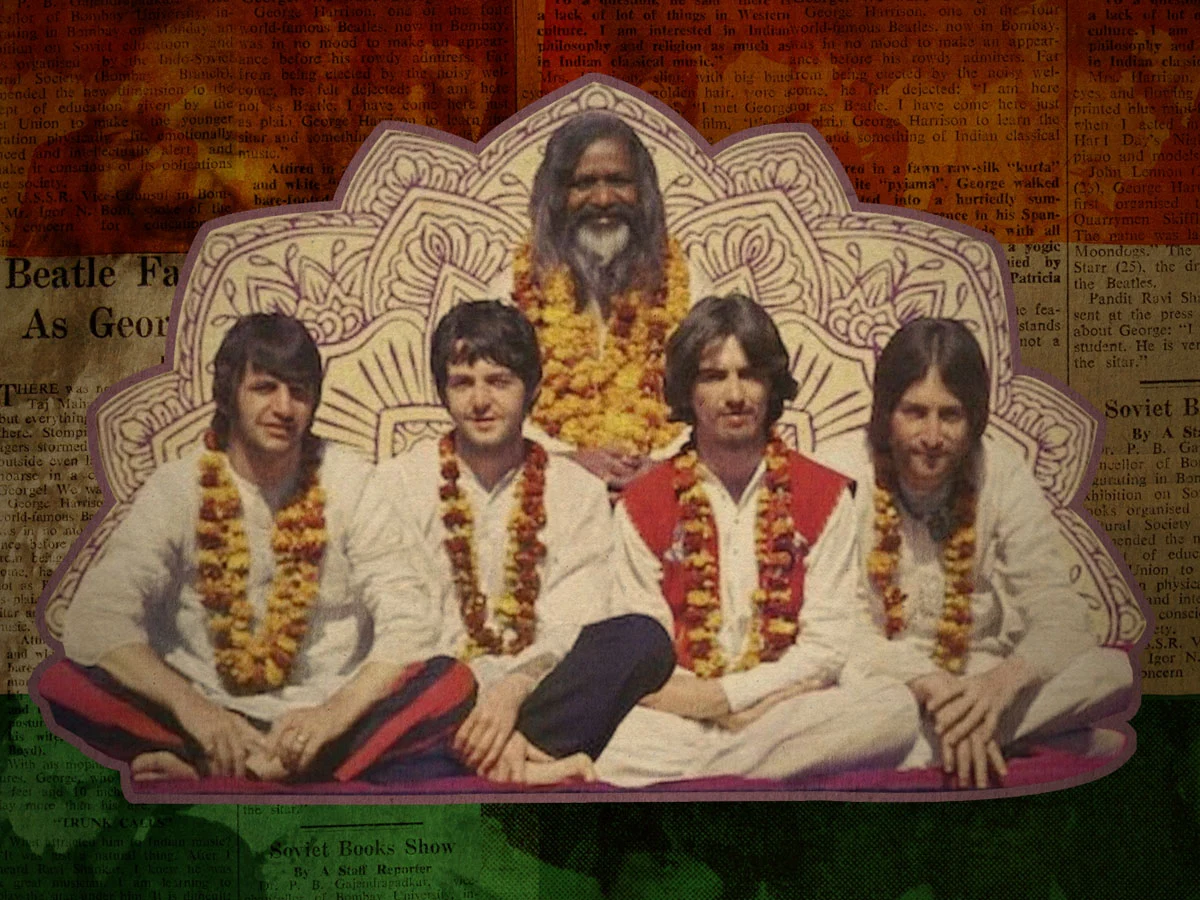
Boyd quickly joined the Spiritual Regeneration Movement, founded in 1958 by Maharishi Mahesh Yogi to promote transcendental meditation globally. Harrison followed in her footsteps, enlisting his fellow Beatles to attend the Maharishi’s lecture in August 1967 at The Hilton on Park Lane in London.

They first assumed their studies with the Maharishi at a training retreat in Bangor, Wales, where they announced that they were giving up drugs to live in alignment with the Maharishi’s teachings. Then, at his invitation, they travelled to Rishikesh, India, the following February 1968, staying at his ashram with their respective girlfriends and wives, alongside the likes of Mia Farrow, Donovan and the Beach Boys’ Mike Love.
The Beatles’ time spent at the Rishikesh ashram was highly publicised in the media, with a slew of photographers and reporters following them to the venue (though they were not allowed entrance). In turn, The Beatles are seen as major figures in helping to garner interest in the study of Eastern spirituality and philosophy in larger Western popular culture. In his 2010 book America Veda, Philip Goldberg wrote that The Beatles’ trip “may have been the most momentous spiritual retreat since Jesus spent those 40 days in the wilderness”.
In the weeks that the Fabs and co studied under the Maharishi, life at the Rishikesh ashram was as idyllic as they could have anticipated. “You would get up in the morning and go down to a communal breakfast,” McCartney recalled in The Beatles Anthology, “Food was vegetarian…and I think we probably had cornflakes for breakfast. After breakfast, you would go back to your chalet, meditate for a little while, have a bit of lunch, and then there might be a talk or a little musical event. Basically, it was just eating, sleeping and meditating, with the occasional little lecture from Maharishi thrown in.”
The somewhat shock of calm that The Beatles felt at the retreat led them towards one of their most fruitful songwriting periods, a result of being removed from the chaos of being in the public eye. Indeed, the tranquil-like setting was like something out of a countercultural dream, sounding perfect on paper: a place where the most famous band in the world could hide from watchful eyes (save for the photographers attempting to get their lenses through the surrounding trees) and restore their creativity lost in the wave of fame and addiction.

John Lennon proclaimed in The Beatles Anthology to have written hundreds of songs after a five-day meditation. The band’s resulting range of 30 to nearly 50 songs written by the four eventually appeared across their self-titled The Beatles, Abbey Road and later solo albums and Beatles anthologies. Perhaps the most well-known of the songs written during this time was the John Lennon-penned ‘Sexy Sadie’, initially titled ‘Maharishi’, written in the aftermath of allegations against the Maharishi that would mark the beginning of the end of the era’s optimism.
For context, Starr and his wife, Maureen, had left the retreat after their first week, McCartney left around three weeks after them, leaving Harrison and Lennon, who were most dedicated to the transcendental meditation practices the Maharishi taught. “We’re not here to talk about music,” Harrison famously told McCartney (as told in The Beatles Anthology), when asked to talk about the next Beatles album, “We’re here to meditate”. Some two weeks later, Harrison and Lennon left, as well, after becoming aware of rumours of sexual misconduct by the Maharishi towards a female follower of his.
While there remains no official nor definitive account of the allegations against him, but reportedly, his misconduct was towards one of the women in the ashram, often traced back to Alexis ‘Magic Alex’ Mardas, a Greek electronics engineer and then-head of Apple Electronics, who offered his account in a statement to The New York Times. Notably, Mia Farrow maintained that the Maharishi made an unwelcome advance towards her, writing in her 1997 memoir What Falls Away, “Suddenly I became aware of two surprisingly male, hairy arms going around me”. She soon left the ashram as well.
“I said, ‘We’re leaving’,” Lennon recalled telling the Maharishi, as recounted in The Beatles Anthology, “‘Why?’ ‘Well, if you’re so cosmic you’ll know why’. And I just kept saying, ‘You ought to know’. And he gave me a look like, ‘I’ll kill you, you bastard’.”

In turn, ‘Sexy Sadie’ was loosely written with the events that transpired in his mind and, as he later told Playboy, the opening lines were previously, “Maharishi, what have you done? You made a fool of everyone…”, with Cynthia Lennon later recounting that John felt that the Maharishi had “too much interest in public recognition, celebrities and money”.
In the decades since The Beatles’ visit to the Rishikesh retreat, some participants expressed their doubts over the accusations against the Maharishi, with Harrison and McCartney offering their apologies to him in the 1990s. “This whole piece of bullshit was invented,” Harrison later expressed in The Beatles Anthology, “There were a lot of flakes there; the whole place was full of flaky people. Some of them were us.”
The accusations against the Maharishi cast a dark glare over the counterculture, at large. In The Beatles’ effort to seek some semblance of peace and higher power while extracting themselves from the throes of addiction, their misguided trust in a man posed by the public as their ‘spiritual guru’ saw their spiritual foundation quickly dismantled.
Further, it exposed an undercurrent of sinister behaviours and weaponised power that would haunt the counterculture’s continued attempts to prioritise optimism, peace and communal trust. Beneath the collective search for a form of enlightenment was a shallow depth. The Beatles’ time in India and the events that transpired there were an early instance of faith in higher powers being put into question. The practices of meditation and promotion of spirituality and philosophy certainly represented a form of salvation, but an individualist one, at that.
“Meditation and Maharishi have helped make the inner life rich for me,” Harrison told Paul Saltzman, quoted in his book The Beatles In India, “The meditation buzz is incredible. I get higher than I ever did with drugs. It’s simple, the vibration is on the astral plane, and it’s my way of connecting with God.”
“Like, we’re the Beatles after all, aren’t we?,” Harrison continued, “We have all the money you could ever dream of. We have all the fame you could ever wish for. But, it isn’t love. It isn’t health. It isn’t peace inside. Is it?”