\ The Living Room Where Modern Music Was Born: Les Paul on Electronics, Invention, and the Guitar That Changed Everything
“I knew from the beginning that there was a great marriage between electronics and music,” Les Paul once said. And he was not guessing. He was speaking from experience — the kind of experience that comes from taking apart telephones in his living room as a teenager, long before anyone had ever heard of rock and roll.
“I’d play my guitar and my mother or my brother would tell me how good it sounded, but I wanted to hear it,” he recalled. “The only way that could happen was if I could hear it played back. So I built a crank phonograph and turned it into a recording device like Edison had — without even knowing who Edison was.”
That combination of curiosity, humility, and relentless tinkering would define Les Paul’s extraordinary life. He was not trained as an engineer. He did not have a laboratory. He had a living room — and in that living room, he changed the course of music forever.
“The electronics were all in my living room,” he said. “In addition to the phonograph I had a player piano, a telephone and a radio. I took the telephone apart at the receiver end, and when I looked at it I figured that the two coils were humbucking and quickly understood what the receiver was doing. Then I looked at the mouthpiece and worked out what that was doing. It was all right there in the living room. I never had to leave it — and I didn’t.”
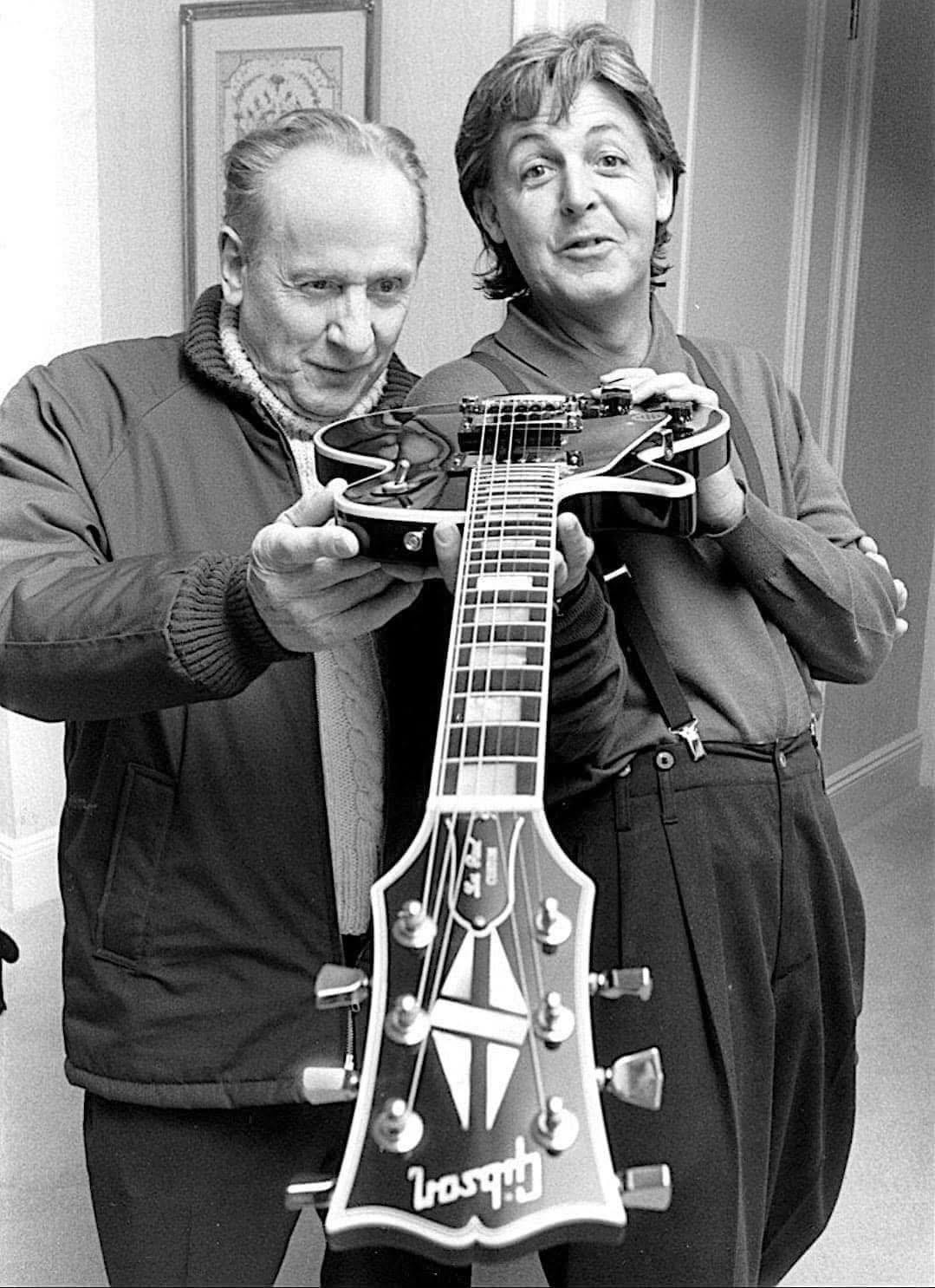
That moment of discovery — looking inside a telephone and understanding the principles of humbucking — would eventually lead to the creation of the Gibson Les Paul guitar, one of the most iconic instruments in history. But more than that, it led to the development of multitrack recording, allowing musicians to layer sounds in ways that had never been possible before. Every modern recording studio owes a debt to the experiments Les Paul conducted in his living room.
A longstanding member of the Rock & Roll Hall of Fame, as well as an inductee into the Inventors’ Hall of Fame — alongside such esteemed company as Benjamin Franklin, the Wright Brothers, and Alexander Graham Bell — Les Paul is one of the authors of modern music. He was at the forefront of guitar amplification, pioneered the technology of multitrack recording, and refused to stop creating even as the decades passed.
At the age of 91, he still performed weekly sell-out gigs at New York’s Iridium Jazz Club, playing the electric guitars that have carried his name since he first invented them in the 1940s and teamed with Gibson to perfect and manufacture them in the 1950s. His hands, still nimble, still inventive, still finding new ways to make the instrument sing, were the same hands that had taken apart a telephone in a living room nearly eighty years earlier.
Les Paul died in 2009, at the age of 94. But his legacy is not confined to a museum or a history book. It is heard every time a guitarist plugs into an amplifier. Every time a recording engineer punches in a new track. Every time a musician layers a harmony that would have been impossible without multitrack recording. He did not set out to change the world. He set out to hear himself play. And in doing so, he gave the world the tools to hear everything differently.
“I never had to leave the living room,” he said. “And I didn’t.”
The living room is gone now. The telephone he took apart is a relic. But the music — the endless, evolving, electrified music — remains. And that, perhaps, is the greatest invention of all.