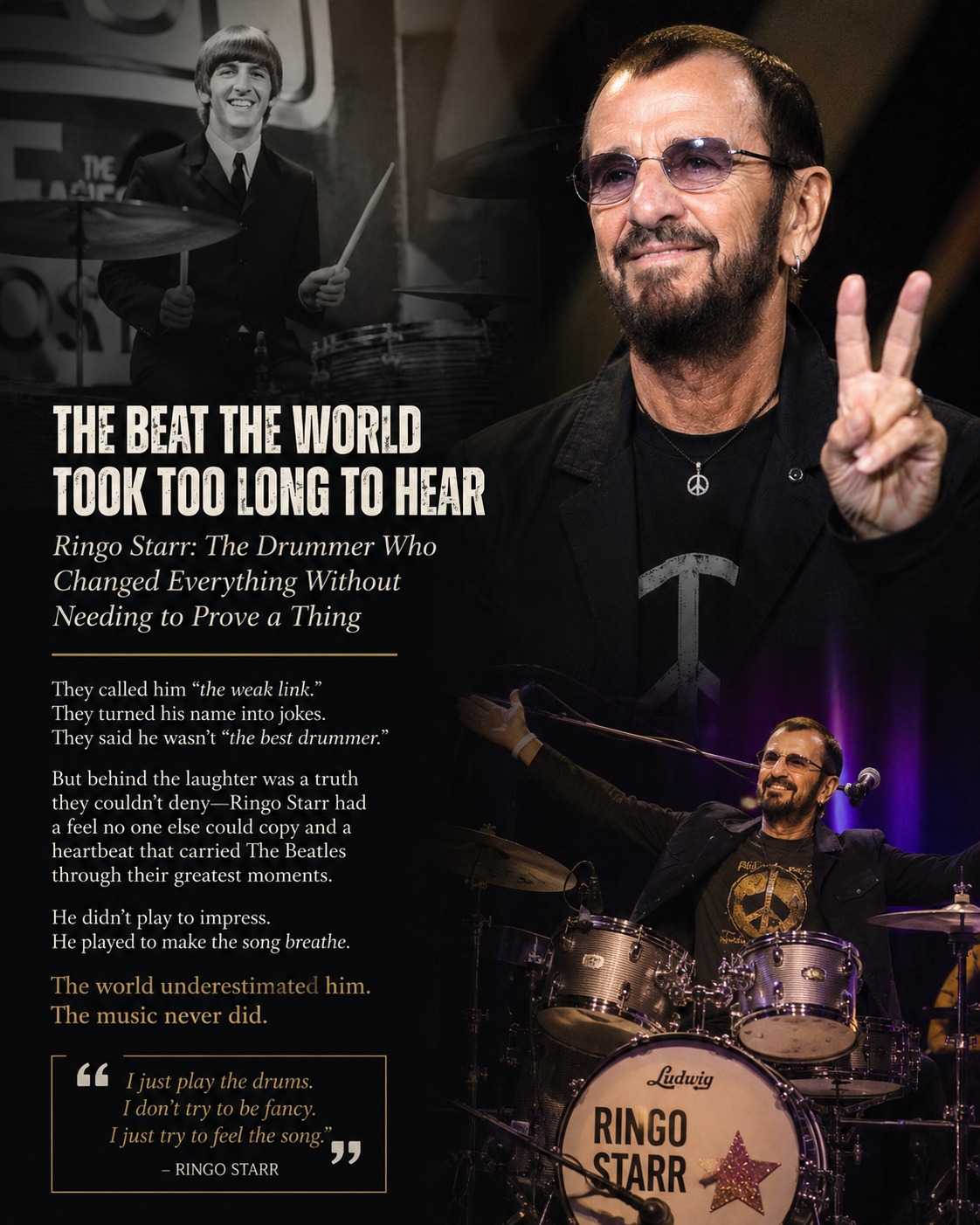
Forget the Jokes. Forget the Years People Underestimated Him. One Drummer Helped Change Music Forever — and the World Took Far Too Long to Admit It.
For decades, Ringo Starr carried one of the strangest myths in music history. People repeated lazy jokes. Critics dismissed his talent. Some treated him like the “lucky Beatle” standing beside bigger personalities.
But while they talked, Ringo kept playing.
The narrative followed him for years. “He’s not even the best drummer in The Beatles” — a quote that was never actually said by John Lennon, yet it stuck. It followed him through interviews, documentaries, and casual conversations among fans. Comedians repeated it. Critics used it to diminish his contribution. And Ringo, for his part, never fought back.
He never defended himself. He never released statements correcting the record. He simply sat behind his drum kit and played.
And somewhere between the hypnotic groove of “Come Together,” the thunder rolling through “A Day in the Life,” and the emotional heartbeat underneath countless Beatles songs, something became impossible to deny: nobody else sounded like him.
Ringo never fought for attention. He never tried to silence critics with ego or flashy solos. His greatness came from something quieter — feel, timing, instinct, and the rare ability to make simple moments unforgettable.
Listen to the fills on “Rain.” The way his drums stumble and recover, creating a tension that no metronome could replicate. Listen to the groove of “Something” — steady, unshakable, allowing the song to breathe. Listen to “Tomorrow Never Knows,” where his drumming becomes hypnotic, almost meditative, carrying the song into uncharted territory.
None of it is accidental. None of it is replaceable.
The world eventually caught up. Musicians defended him. Fans rediscovered him. History corrected itself. Drummers who actually know drumming — the ones other drummers admire — have long understood Ringo’s genius. His ability to serve the song, to find the perfect part and play it with unerring consistency, is a skill that cannot be taught.
Now, decades later, the jokes have faded. The myth has been exposed. And Ringo Starr remains — not as the lucky one, but as the essential one. The heartbeat of the most important band in history. The drummer who proved that feel matters more than flash.
Some artists demand recognition. Others become so essential that time recognizes them anyway.
Ringo never needed to be the loudest voice in the room. He just needed to be the rhythm. And that rhythm has never stopped. 🥁