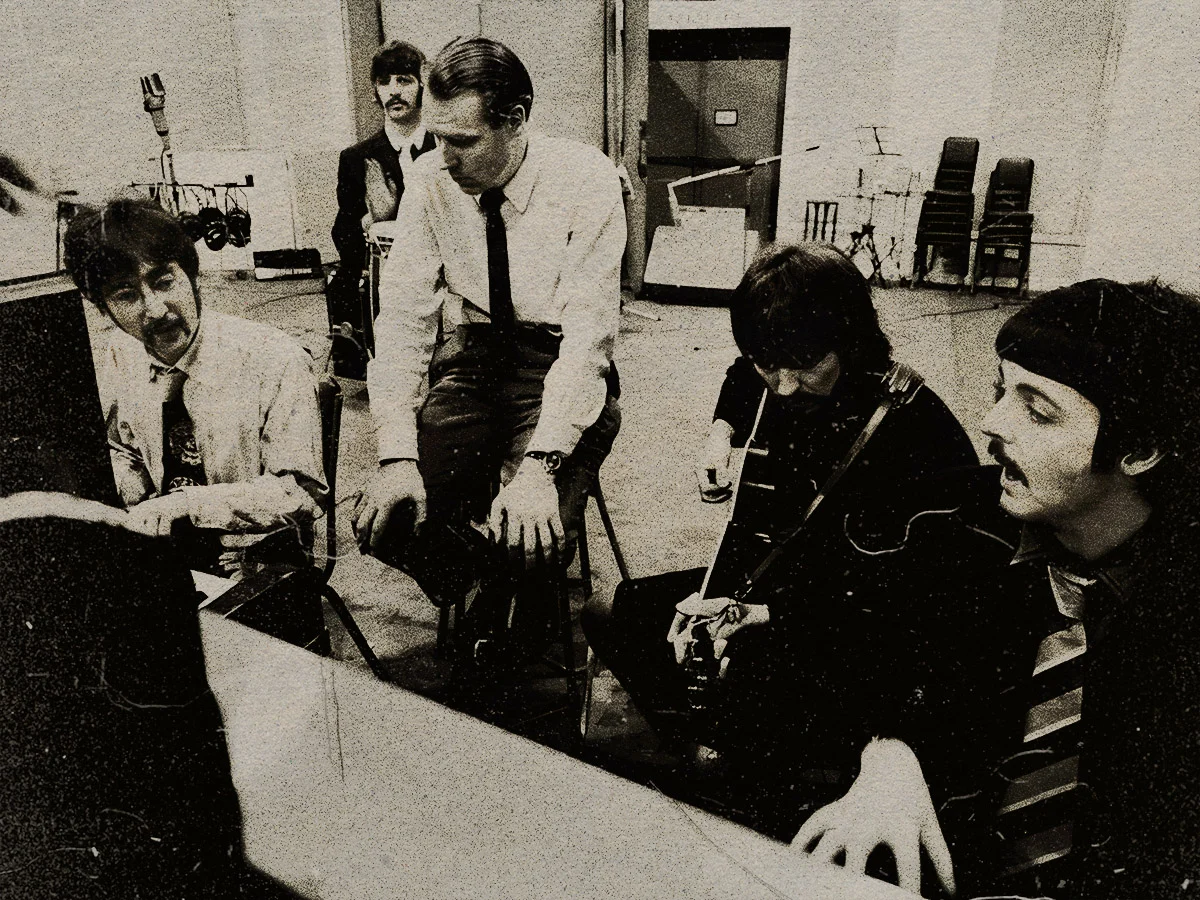
George Martin was essential to the success of The Beatles.
As one of the more cultured voices in the group’s ears, gently suggesting some of their finest arrangements and orchestral moments, Martin steered the band in the right direction. Some have even argued that without their beloved producer, the Fab Four would have remained a provincial club band, eventually fading into obscurity like so many of their contemporaries. I’d disagree.
Such a suggestion implies a frankly elitist view of music—that working-class, untrained musicians are incapable of making great work. Their inspiration must have come from a higher-class education imparted via any necessary source. Martin’s classical training certainly allowed The Beatles greater control over their sound, but while his ear and brain offered the Liverpudlians a great sense of their creations, his greatest contribution was probably his honesty.
That honesty was not always easy for the band to hear, particularly as their confidence grew alongside their fame. By the mid-1960s, The Beatles were no longer just a promising group looking for guidance; they were redefining the boundaries of popular music. Even so, Martin maintained a level-headed perspective, acting as a counterbalance to their more indulgent tendencies and ensuring that their experiments remained grounded in something coherent.
It also helped foster a creative environment built on trust rather than deference. The band knew that when Martin offered criticism, it was in service of the music rather than ego or authority. That dynamic allowed ideas to be challenged without derailing the process, creating a space where bold concepts could be refined rather than simply accepted or dismissed outright.

Martin was nothing if not transparent. The Beatles’ success made John Lennon, Paul McCartney, George Harrison and Ringo Starr semi-mythological figures. Martin did his best to cast the Liverpool quartet in a more realistic light. In a 1964 interview, he opened up about his fated first meeting with the band: “The first thing that I heard was a recording they’d made, rather a bad one, and I didn’t do a sort of backwards somersault and hit the ceiling and say, ‘God, this is find of the century’ or anything like that.”
For Martin, the group did have something of interest, though: “I just thought they were interesting and thought they had something slightly different, and I liked to know something more about them, so I got them in the studio”.
Martin’s frankness was a useful tool during the creation of The Beatles’ 1967 album Sgt Pepper’s Lonely Hearts Club Band, for which George Harrison composed the slinky psychedelic number ‘Only A Northern Song’. In his book A Hard Days Write, Steve Turner sheds light on the bitter origins of the track: “The song was a sly dig at the business arrangements of the Beatles,” he begins. “Their songs had always been published by Northern Songs Ltd, 30% of whose shares belonged to John and Paul with Ringo and George owning only 1.6% each. This meant that John and Paul, in addition to being the group’s main songwriters, were benefiting again as prime shareholders in the publishing company. As far as Northern Songs was concerned, George was merely a contracted writer.”
“I realised Dick James had conned me out of the copyrights for my own songs by offering to become my publisher,” remembered Harrison of the track later. “As an 18 or 19-year-old kid, I thought, ‘Great, somebody’s gonna publish my songs!’ But he never said, ‘And incidentally, when you sign this document here, you’re assigning me the ownership of the songs,’ which is what it is. It was just a blatant theft.”
With a lesson in music business learned, Harrison decided to aim a barbed track squarely at those who had done him wrong, a trick he would pull off many times in the future: “By the time I realised what had happened, when they were going public and making all this money out of this catalogue, I wrote ‘Only A Northern Song’ as what we call a ‘piss-take,’ just to have a joke about it.”
The Beatles went ahead and recorded the track, but George Martin’s intense dislike of the timpani-coddled number caused him to cut it from Sgt Pepper’s tracklist. The producer would later say that it was the “track he hated most [from Harrison].”
Arguably, Martin’s refusal to take anything less than perfect is why Sgt. Pepper’s remains one of the finest concept albums of all time. ‘Only A Northern Song’ was replaced by Harrison’s crowning glory, ‘Within You Without You’, a track that saw The Beatles pioneer the use of tape loops and cement Indian traditional music as an important feature of ’60s pop. ‘Only A Northern Song’, on the other hand, eventually found its way onto Yellow Submarine.