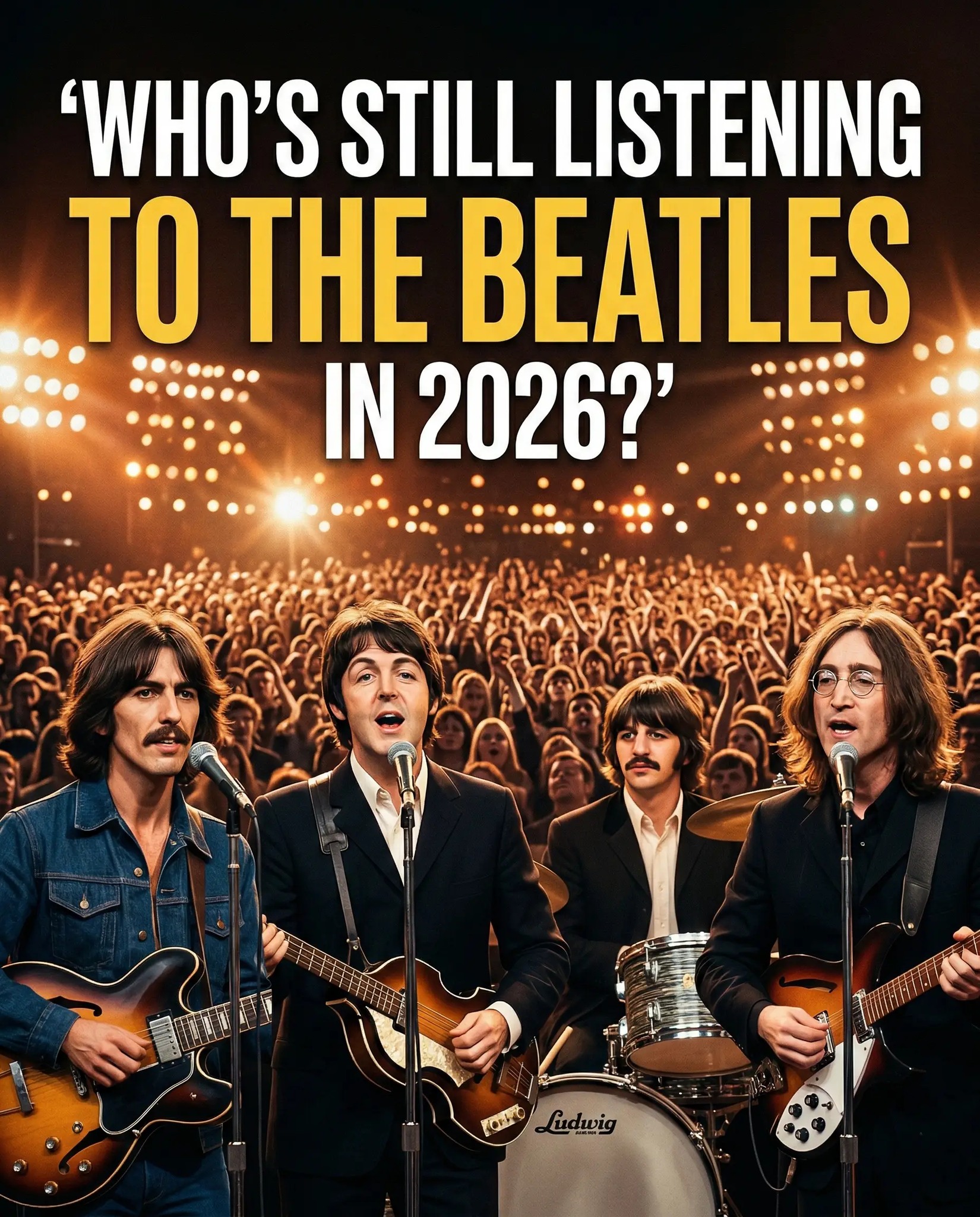
IN 2026, THE BEATLES ARE NOT A MEMORY — THEY ARE A PRESENCE
You don’t press play to revisit the past.
You press play because it still feels real.
When “Let It Be” begins, something softens. Not out of nostalgia — out of recognition. The piano chords arrive like an old friend walking through the door. The words land the way they always have: “When I find myself in times of trouble…” and suddenly, you’re not alone anymore.
When “Hey Jude” rises into that final chorus, strangers still find each other in the melody. Watch any crowd, any generation. They don’t sing along to prove they know the words. They sing because the song needs to be sung. Because that “na na na” isn’t just a coda — it’s release. It’s permission to feel.
And when “Here Comes the Sun” starts, it doesn’t sound old. It sounds like light breaking through again. Three minutes of pure, unguarded optimism, written in a garden during a difficult time, now carried across six decades like a note passed between friends.
That’s the Difference
Their power was never just popularity. It wasn’t screaming crowds or Ed Sullivan appearances or even the mythology that grew around them. All of that would have faded if the songs hadn’t held.
What held was the songwriting. Melody paired with meaning. Simplicity that never felt shallow. Depth that never felt distant.
They changed boldly. They experimented. They grew. But at the center of it all, they stayed human.
Still Holding
In 2026, trends move fast. Attention fades faster. Algorithms chase the next thing, and the next thing after that. Music is consumed in playlists, shuffled, skipped, background noise for other activities.
But The Beatles remain.
Not as artifact. Not as history lesson. As presence. As something you still choose to hear, not because you should, but because you want to.
A teenager discovers “In My Life” and hears their own heart for the first time. A couple dances to “Something” at their wedding, fifty years after it was written. A parent sings “Golden Slumbers” to a child who will one day sing it to theirs.
Some Music Fades
Some music fades. Some becomes wallpaper. Some becomes trivia.
The Beatles became oxygen.
Not because they were perfect. Not because they were gods. Because they were four people who figured out how to turn feeling into sound — and that sound turned out to be universal.
So in 2026, when you press play, you’re not looking back.
You’re arriving. Again. Still.
Because some songs don’t age. They just wait for you to catch up.