# An Unlikely Alliance: Paul McCartney, Bad Bunny, and the Battle Over the Super Bowl Stage
When Paul McCartney took the field at Super Bowl XXXIX in 2005, he did something unexpected. As a British citizen performing in the shadow of the Iraq War, the former Beatle paused between songs and addressed the crowd directly: “America, you’ve been great for us. You’ve been great for the world. We’re with you.”
Nineteen years later, McCartney’s quiet patriotism has become an unexpected flashpoint in the most contentious Super Bowl halftime debate since Janet Jackson’s wardrobe malfunction.
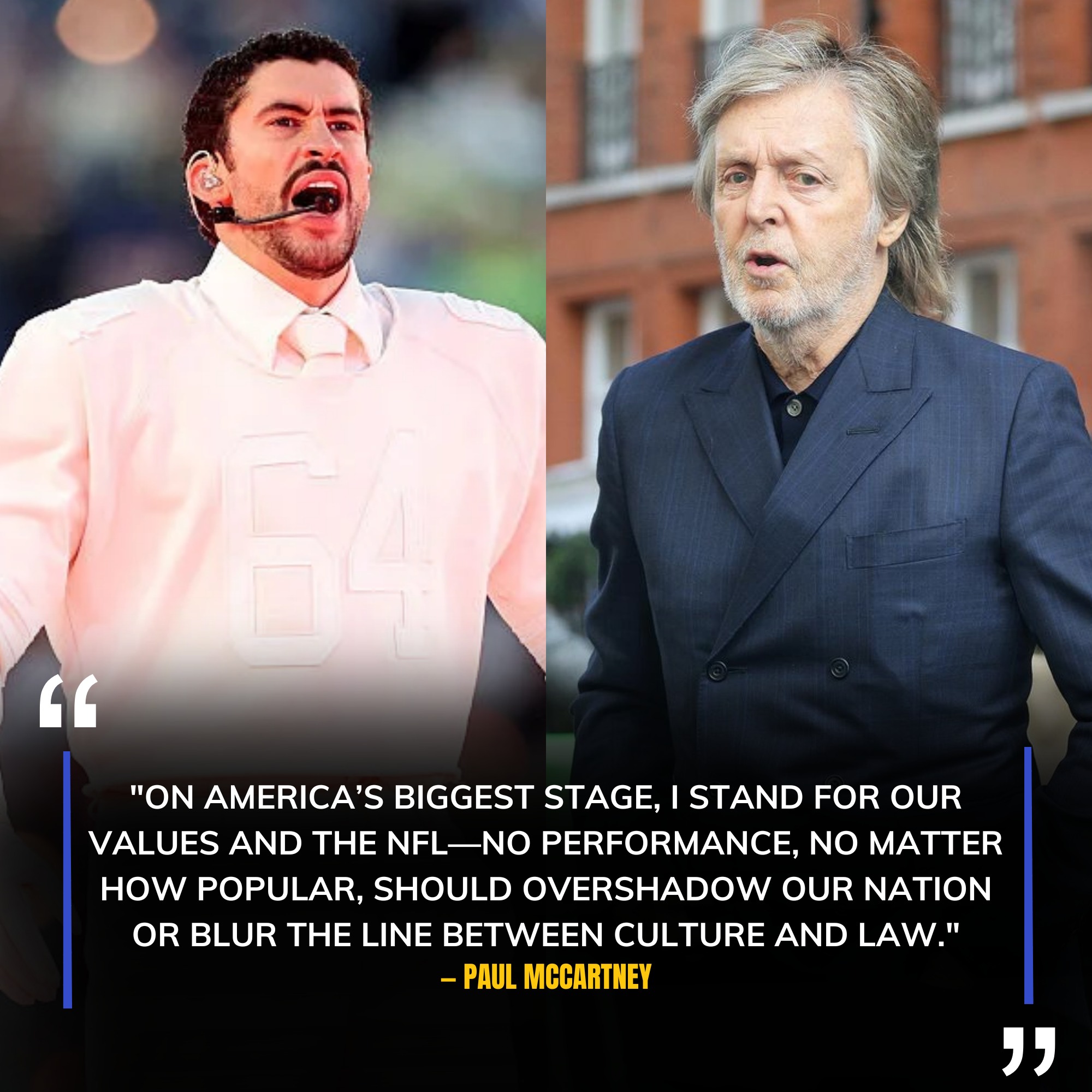
This year’s headliner, Puerto Rican superstar Bad Bunny, performed nearly entirely in Spanish—a 13-minute celebration of Latin American identity that drew 133.5 million viewers and immediate condemnation from conservative figures who deemed it un-American. But as critics questioned whether a Spanish-language performance belonged on America’s biggest stage, a surprising counter-narrative emerged: McCartney himself, through representatives, quietly signaled support for the very artistic freedom his critics now sought to police.
The juxtaposition has exposed uncomfortable questions about whose Americanness is accepted—and whose is perpetually up for debate.
## “I Don’t Speak Spanish”: The White Player Backlash
The criticism began weeks before kickoff. When the NFL announced Bad Bunny as headliner, several current and former players voiced objections that blurred musical taste with immigration politics.
Former wide receiver Brandon Marshall, speaking on a sports commentary show, said: “I respect the culture, but the Super Bowl is America’s game. We’re losing our identity when we can’t even understand the words at our own halftime show.” He later clarified he wasn’t criticizing Latinos broadly—only the language choice.
Veteran linebacker Clay Matthews questioned the selection on a podcast: “There are so many great American artists. Why are we importing someone who won’t even sing in English?” When the host noted that Puerto Ricans are U.S. citizens, Matthews responded: “You know what I mean. Culturally.”
The phrase “culturally American” appeared repeatedly in player and pundit criticism—a vague designation that seemed to include British rock bands and Canadian pop stars but exclude Puerto Rican reggaeton performed in Spanish. Several players shared Turning Point USA’s competing “All-American Halftime Show” featuring Kid Rock and Brantley Gilbert, which drew six million viewers compared to Bad Bunny’s 133.5 million.
Not all players agreed. Philadelphia Eagles offensive tackle Jordan Mailata, an Australian citizen, defended Bad Bunny on social media: “As someone who wasn’t born here, I know what it means to be welcomed by this country. That’s the America I know. That’s the Super Bowl I played in.” San Francisco 49ers defensive end Nick Bosa, who has previously engaged in culture war controversies, conspicuously declined comment.
## Paul McCartney’s Quiet Intervention
Amid the escalating debate, McCartney’s camp made an unusual move. The musician, now 83, does not typically involve himself in contemporary pop controversies. But when asked by the Associated Press about the Bad Bunny backlash during a press availability for his upcoming tour, McCartney offered a carefully worded response:
“When we played the Super Bowl, nobody asked if we were American enough. They just listened to the music. That’s what the Super Bowl should be—listening to the music, celebrating the moment. America is big enough for all kinds of voices.”
The statement, while measured, carried unmistakable weight. It reframed the debate not as left versus right, but as a question of consistency. If McCartney’s British-accented “Hey Jude” singalong was embraced as a unifying American moment, why was Bad Bunny’s Puerto Rican-accented Spanish treated as division?
McCartney went further in a subsequent interview with Rolling Stone, reflecting on his own history of navigating American cultural politics. “We were banned from some radio stations in the 60s because they said our music was corrupting youth,” he said. “Now they play ‘I Want to Hold Your Hand’ at weddings. The gatekeepers always think they know what America wants. They’re always wrong about what endures.”
Though McCartney never directly named Bad Bunny’s critics, the implication was unmistakable: today’s “un-American” is often tomorrow’s classic.
## The Bad Bunny Performance: Intentionally Unapologetic
Bad Bunny—born Benito Antonio Martínez Ocasio in Vega Baja, Puerto Rico—entered the Super Bowl stage knowing exactly what he was doing. His halftime show opened with a *jíbaro*—Puerto Rico’s traditional mountain farmer—declaring “Qué rico es ser latino” before the set transformed into a streetscape of island life: domino players, a piragua vendor, a salmon-pink *casita*.
He climbed an electrical pole, a pointed reference to Puerto Rico’s chronic power failures and the controversial federal response to Hurricane Maria. He performed surrounded by flags from across Latin America. At the finale, he held up a football inscribed with five words in English: “Together, We Are America.”
The symbolism was deliberate. Bad Bunny had used his Grammy acceptance speech the previous week to declare “ICE out,” adding: “We’re not savage. We’re not animals. We’re not aliens. We are humans and we are Americans.” The Super Bowl stage extended that argument through imagery rather than rhetoric—but the meaning was no less clear.
Of the 13-minute set, approximately 90% was performed in Spanish. The only English phrases were “Yeah yeah yeah” and the closing statement on the football.
## Citizenship, Culture, and the Citizenship Question
A recurring theme among critics was the implication that Bad Bunny was somehow “not American.” Jake Paul labeled him “a fake American citizen performing who publicly hates America.” This required ignoring that Puerto Ricans have been U.S. citizens since 1917, that Bad Bunny was born on American soil, and that he has headlined American stadiums for years.
The comparison to McCartney—a beloved foreigner—made the subtext visible. McCartney’s Britishness has never been framed as disqualifying for Super Bowl representation. When The Who performed in 2010, no commentator asked whether “American” music required English-born Pete Townshend. When U2 performed in 2002, their Irishness was framed as international solidarity, not cultural infiltration.
Bad Bunny, by contrast, is not foreign at all—and yet his Americanness required defense.
“People kept asking me: is Bad Bunny American?” wrote Boston Globe columnist Renée Graham. “The question itself was the answer. No one asks if Paul McCartney is American. We know he isn’t. And we don’t care. Bad Bunny is American. And apparently, for some people, that’s exactly the problem.”
## Immigration, ICE, and the Subtext of the Backlash
The immigration framing was never far from the surface. Bad Bunny’s Grammy speech, delivered days before the Super Bowl, explicitly criticized ICE enforcement. His halftime imagery—the Puerto Rican farmworker, the electrical pole, the flags—told a story of displacement and resilience.
When Jill Zarin said on a podcast that “there were literally no white people in the entire thing” and speculated that “I think it was an ICE thing,” she articulated what other critics implied: that the performance was not merely music but political advocacy, and that advocacy was unwelcome in a space they considered culturally white.
Zarin later clarified she “didn’t mean it that way” but maintained the performance was “too political for the Super Bowl.”
The contrast with McCartney’s 2005 performance is instructive. McCartney, performing during wartime, dedicated “Freedom” to American troops and received standing ovations. His politics were broadly aligned with mainstream American sentiment. Bad Bunny’s politics challenge the immigration enforcement status quo. Both were political; only one was punished for it.
## The NFL’s Calculated Gamble
The NFL, under guidance from Jay-Z’s Roc Nation, has increasingly used the halftime show to signal cultural inclusion. Beyoncé’s 2016 performance evoked the Black Panthers. Jennifer Lopez and Shakira’s 2020 show featured children in cages, directly criticizing Trump-era family separation policies. Each generated conservative backlash; each was defended by the league as artistic expression.
This year was no different. Commissioner Roger Goodell defended Bad Bunny months before the performance, stating that the artist “understood the platform he was on, and that this platform is used to unite people.” After the show, the NFL issued a brief statement celebrating its viewership numbers and “the diversity of our audience.”
The league’s calculus is demographic and economic. Latino viewers represent the NFL’s fastest-growing demographic segment. International games in Mexico City sell out within hours. The halftime show, once a staid college marching band exhibition, is now a global marketing event.
But the backlash revealed the limits of that strategy. The NFL can book Latino artists, but it cannot control how audiences receive them—nor can it prevent those audiences from reading immigration politics into performances by Puerto Rican artists. For many critics, Bad Bunny was not a musician. He was a symbol of demographic change they oppose.
## McCartney’s Legacy and the Future of the Halftime Show
McCartney’s intervention may prove significant beyond the immediate controversy. By lending his cultural stature to an implicit defense of Bad Bunny’s artistic freedom, he created permission for other legacy artists to weigh in. Elton John, also British, praised the performance as “vibrant and joyful.” Mick Jagger reportedly sent Bad Bunny a note of congratulations.
More importantly, McCartney’s statement reframed the debate from “Is this American?” to “Why do we keep asking that question?” His own history—the Beatles’ early radio bans, their evolution from foreign novelty to American institution—offered a template for understanding cultural assimilation. What seems foreign and threatening in one generation becomes canonical in the next.
Whether Bad Bunny will achieve that canonical status remains to be seen. His halftime performance was not universally beloved even among those who defended it; some viewers simply didn’t enjoy the music. But the shift from aesthetic criticism to citizenship questioning revealed something about American cultural gatekeeping that McCartney, perhaps unintentionally, illuminated.
## Conclusion: The Question We Keep Asking
The Super Bowl halftime show has become a recurring referendum on American identity. Who stands on that stage, in what language, wearing what symbols—these choices are read as statements about who belongs in America’s biggest shared moment.
Paul McCartney belonged. No one debated his appropriateness. No one questioned whether a British man singing about love could represent American football. No one organized an alternative halftime show with American artists performing American songs for American viewers.
Bad Bunny faced all of this. And the difference between their experiences cannot be explained by citizenship, by musical quality, or by the politics of their performances. It can only be explained by what critics meant when they said “culturally American”—a category that includes British knights and excludes Puerto Rican reggaetoneros.
McCartney, to his credit, seemed to recognize this. “America is big enough for all kinds of voices,” he said. The question is whether America agrees.
For 133.5 million viewers on Super Bowl Sunday, the answer was yes. For the critics who saw a foreign intrusion where others saw a fellow citizen, the debate continues. And Paul McCartney—the Beatles’ beloved bassist, the knighted foreigner, the honorary American—has quietly made clear which side he’s on.