# **”I Created a Monster”: How Freddie Mercury’s Munich Prophecy Haunts the Age of Digital Fame**
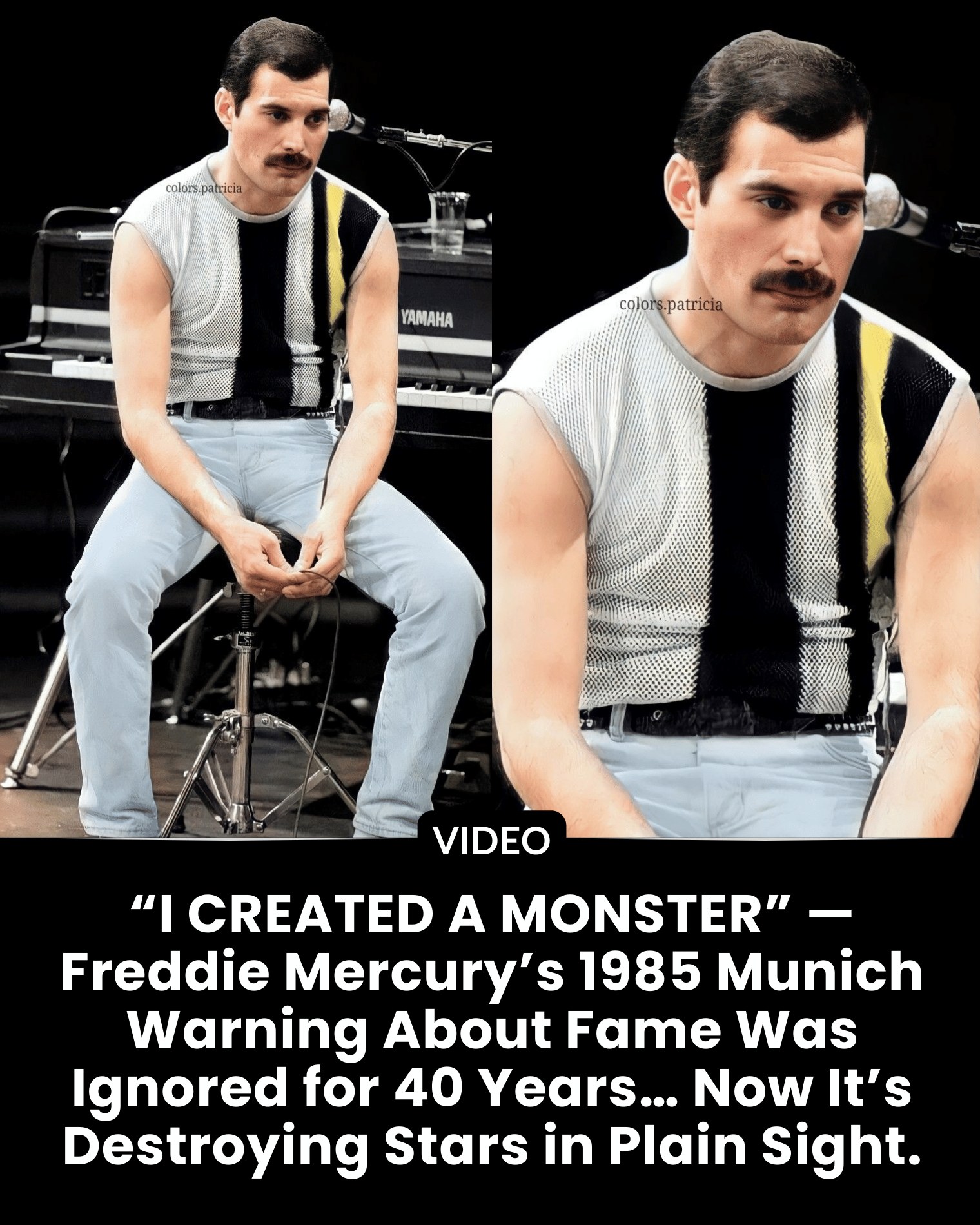
In a dimly lit Munich hotel room in 1985, at the dizzying peak of his global fame, Freddie Mercury leaned into an interview and offered a verdict not on his music, but on the phenomenon that created it. **”I created a monster,”** he said, his voice a mix of defiance and exhaustion, gesturing not at himself, but at the insatiable, distorted entity known as “Queen” and “Freddie Mercury,” the global brand. It was a rare, unguarded moment of clarity from a man who understood the Faustian bargain of superstardom better than most. For decades, the comment was filed away as a rock star’s witty lament. Today, it reads less like a quip and more like a **prophecy we failed to heed**, a blueprint for the very public unraveling of modern celebrity.
### **The Munich Diagnosis: What Mercury Saw Coming**
When Mercury spoke of the “monster,” he wasn’t just talking about busy schedules. He was diagnosing the **dehumanizing mechanics of fame** he had already experienced:
* **The Loss of the Private Self:** He famously built the fortress of Garden Lodge to protect his true, quiet self from the gargantuan public persona. “You are two different people,” he explained. The monster was the doppelgänger that consumed the man.
* **The Insatiable Public Appetite:** The monster was fed by an endless demand for hits, spectacle, and personal revelation. He understood that fame wasn’t a destination but a treadmill that sped up the more you succeeded.
* **Artistic Expectation as a Cage:** After “Bohemian Rhapsody,” every new Queen album was expected to be an event, a groundbreaking spectacle. The monster demanded constant evolution and shock, which could stifle pure creativity.
### **The Prophecy Fulfilled: The Monster in the Digital Age**
If Mercury’s monster was fed by 20th-century media—tabloids, stadium tours, MTV—the 21st century has genetically engineered it into something infinitely more voracious and destructive. His warning manifests today in horrifyingly literal ways:
| **Mercury’s 1985 Warning** | **The 2024 Digital Reality** |
| :— | :— |
| **”You are two different people.”** | The curated **Instagram persona** vs. the private self, leading to severe identity dissociation and mental health crises. The pressure to be “on” 24/7 is absolute. |
| **The insatiable public appetite.** | The **algorithmic monster** of TikTok, YouTube, and streaming services that demands constant content, engagement, and virality. Success is ephemeral, forcing relentless output. |
| **The loss of the private self.** | **Ubiquitous surveillance** via smartphone cameras, social media deep-dives, and fan-armies that unearth every past tweet or acquaintance. There is no Garden Lodge wall high enough. |
| **Artistic expectation as a cage.** | The **tyranny of the niche and the viral**. Artists are trapped by the data of what “works,” pressured to replicate past viral hits rather than explore, leading to creative burnout. |
We now watch stars **crumble in plain sight**—on live streams, in erratic tweet storms, through TMZ breakdowns—their every stumble amplified and monetized by the very platforms that made them famous. The monster doesn’t just consume their time; it consumes their mental health, their relationships, and their artistic spirit in real-time for our entertainment. The cyclical breakdowns of figures like Britney Spears, Kanye West, and countless viral stars are not mere personal tragedies; they are **symptoms of the monster Mercury described**, now operating at digital warp speed.
### **The Unheeded Warning: A Collective Failure**
Why was the warning ignored? Because the monster is profitable. The music industry, social media platforms, and tabloid economics are all built on feeding it. We, the audience, are its willing accomplices, trading human empathy for the drama of a public unraveling.
Freddie Mercury’s solution was to build literal and psychic walls, to separate “Freddie” from “Mercury,” and to channel everything into a stage persona so grand it could bear the weight. But that required a pre-digital age where off-switches existed.
Today, his words are a chilling curse we chose to ignore. **”I created a monster”** is no longer just a rock star’s reflection. It is the founding myth of the digital celebrity age—a warning that in building ever more efficient machines for creating stars, we forgot to install an off-switch, and in doing so, we built a perfect engine for their destruction. The monster is no longer on a stadium stage; it’s in everyone’s pocket, and it’s always hungry.