The Merit in the Marker: Brian May, Freddie Mercury’s Legacy, and the Fight for Named Identity
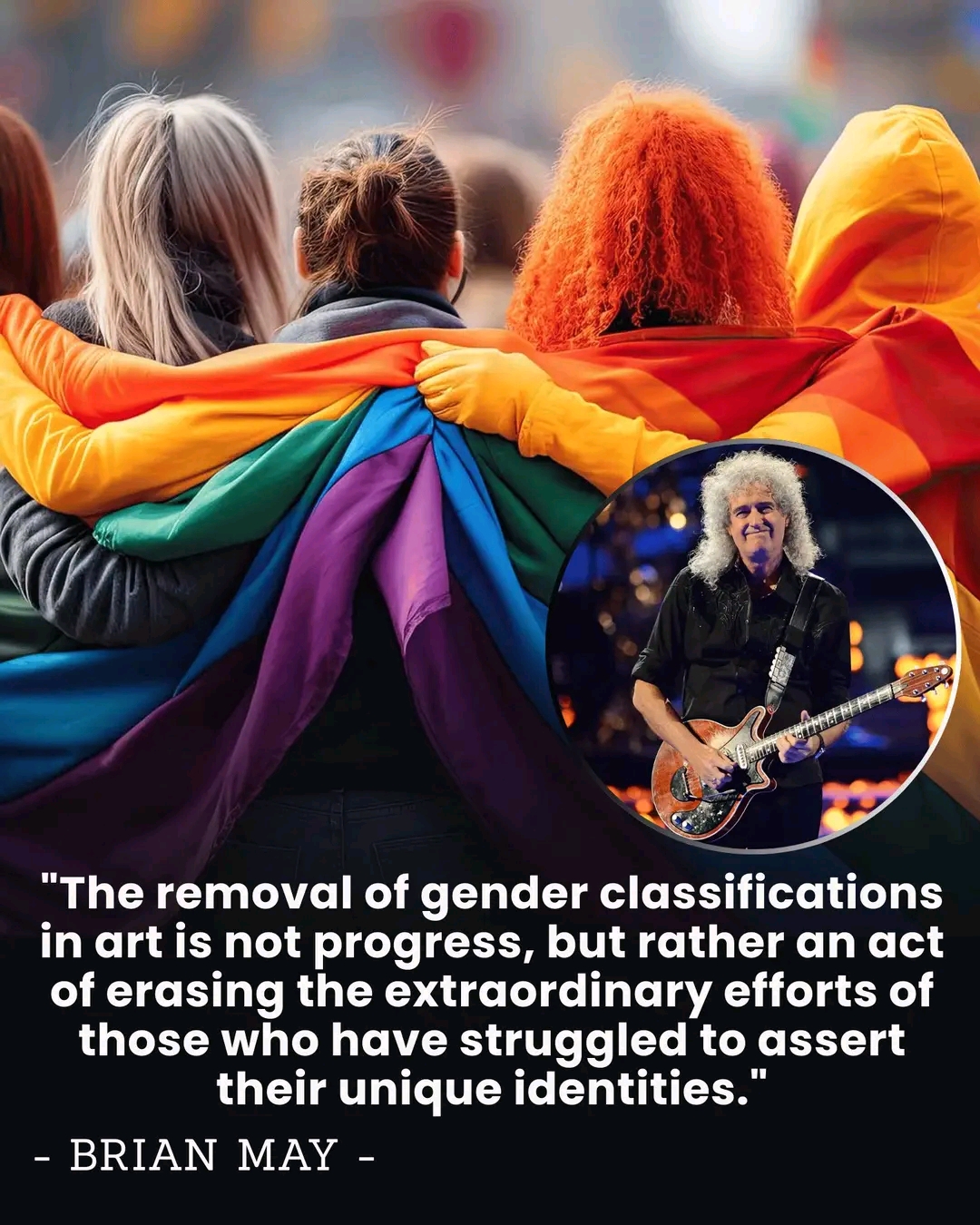
In an era where the push toward inclusion often manifests as the removal of labels, a counter-argument emerges from an unexpected quarter: the storied history of rock and roll. When Sir Brian May, legendary guitarist of Queen, voiced his thoughtful dissent against the music industry’s move to gender-neutral awards, his words were quickly framed by some as a resistance to progress. But to dismiss his stance is to miss its profound depth. May wasn’t arguing against inclusivity; he was mounting a fierce defense of identity hard-won through struggle. By invoking the immortal legacy of Freddie Mercury, he pointed to a terrifying question at the heart of modern equality movements: Does erasing the label risk erasing the history, pride, and visibility it once fought to secure?
—
The Heart of the Argument: A Defense of History
Brian May’s perspective is not born of nostalgia but of lived experience. His critique, centered on awards like the BRITs eliminating “Best Male” and “Best Female” categories, is rooted in a specific historical truth. For decades, these gendered categories were not arbitrary boxes but crucial milestones of recognition. They were platforms that forced the industry to spotlight artists—particularly women—in a landscape where they were often sidelined.
To remove these categories, in May’s view, is to architect a form of amnesia. It risks dissolving the concrete achievements forged in a system that was historically unequal. When he asks, “Is it progress if it flattens difference?” he is challenging the very definition of equality. Is the goal a bland homogeneity where all are treated identically, or is it a vibrant equity that acknowledges different paths, celebrates hard-fought victories, and makes space for all identities to be seen in their distinct power?
The Ghost in the Argument: The Legacy of Freddie Mercury
May’s most potent reference point is the man whose voice defined Queen: Freddie Mercury. Mercury’s artistry was a breathtaking exploration of identity. He was a gay man of Parsi heritage who became the ultimate rock god, his persona a glorious, ambiguous fusion of hyper-masculine power and sublime androgyny. He did not hide; he amplified.
To invoke Mercury in this debate is genius. It asks: would a gender-neutral system have recognized, understood, or celebrated the specific, revolutionary nature of his identity? Mercury’s power came from his difference, from owning every complex facet of himself in a world that demanded conformity. A system that removes the markers of “male” or “female,” May implies, might inadvertently flatten the very contours of identity that icons like Mercury spent their lives sculpting. It threatens to replace proud, specific visibility with a vague, anonymous sameness.
The Other Side of the Stage: The Case for a New Neutrality
The push for gender-neutral awards is driven by a powerful and valid vision of the future. Proponents argue that art should be judged on merit alone, separate from the artist’s gender identity. For non-binary, genderfluid, and trans artists, gendered categories are not milestones but immediate barriers—an archaic binary that excludes them from the start. This view champions a progress that evolves beyond old categories, aiming for a stage where the music is the only thing that matters.
Yet, this is where the philosophical clash becomes clear. It is a tension between two models of fairness:
· Equality as Sameness: A system where all artists enter the same category, judged by identical standards. It aims for purity of evaluation but may ignore the uneven ground from which different artists start.
· Equality as Equity: A system that acknowledges historical and social context, believing that fairness sometimes requires named categories to ensure diverse voices are heard and historic disparities are corrected.
Brian May, shaped by watching friends and collaborators fight for their space, is unequivocally in the latter camp. His position is a warning: in our rush to create a neutral future, we must not dismantle the tools that specific communities forged for their own liberation.
A Deeper Chord: What Are We Really Awarding?
This debate exposes that awards are never just about trophies. They are about cultural meaning. A “Best Female Artist” award in 1975 carried a weight of breakthrough; in 2024, to some, it carries a weight of limitation. The category itself hasn’t changed, but its social meaning has.
May’s intervention forces us to ask what we want our institutions to symbolize. Is the goal a streamlined, efficient system of judgment? Or is it a living, responsive institution that carries the memory of past struggles while making room for future ones? Perhaps the solution isn’t a simple removal but a radical re-imagination—award structures that can simultaneously honor the specific legacy of female artists in rock, celebrate the genius of non-binary pioneers, and enshrine the memory of queer icons like Freddie Mercury, all without forcing them into competition.
The conversation Brian May has reignited is messy, uncomfortable, and essential. It cuts to the core of how societies move forward: not by simply erasing the signs of past battles, but by learning to read them with more nuance, ensuring that in building a bigger table, we don’t sand away the unique grain of every story that earned a seat at it. True progress may not lie in choosing between history and inclusion, but in finding the courage to hold both.