The Psychedelic Rumble: The Night Rock’s Crown Princes Shared a Stage and Lost Control
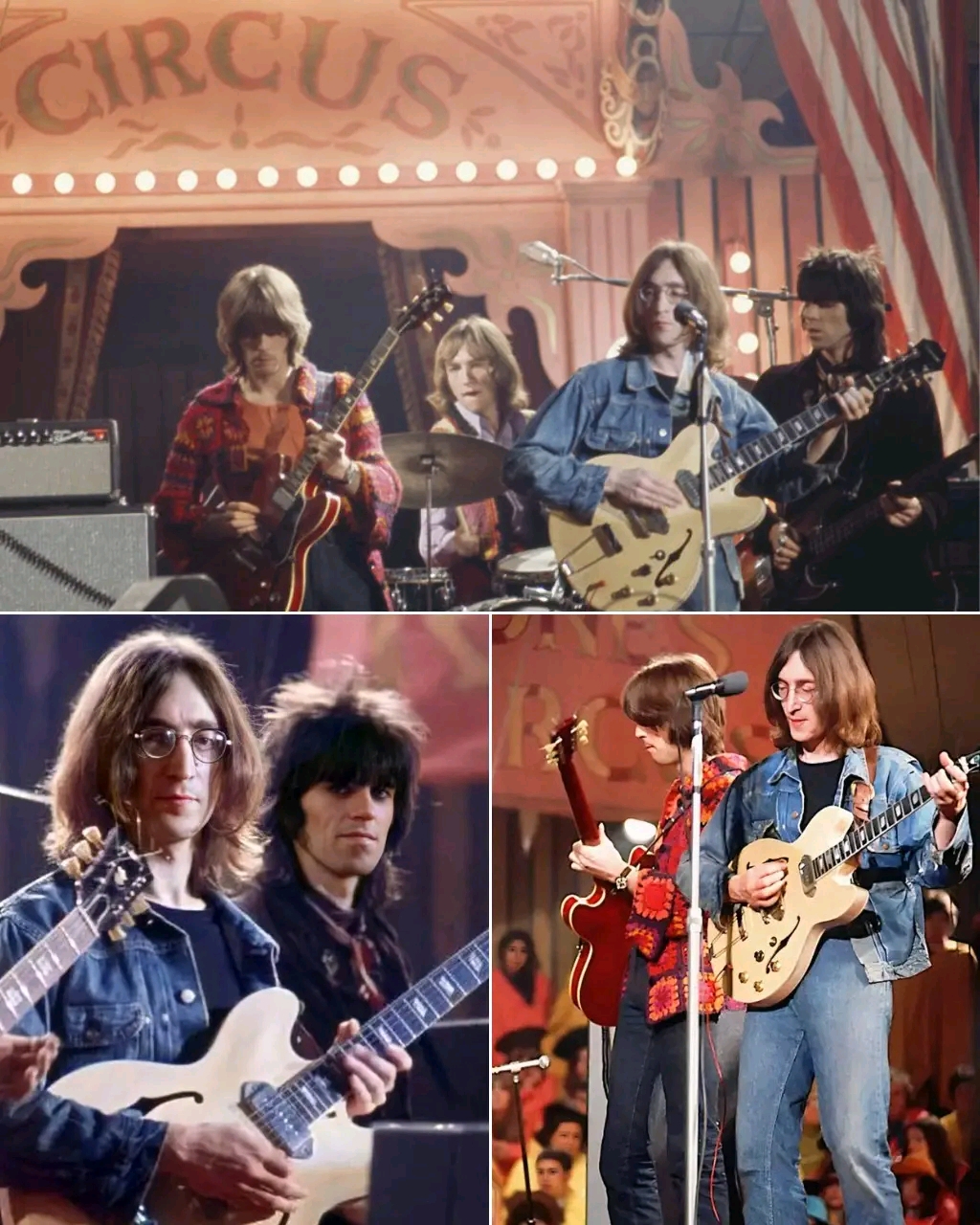
The date was December 11, 1968. The venue: The Rolling Stones’ Rock and Roll Circus, a televised spectacular conceived as a festive, genre-bending showcase. The Stones, seeking to reassert their primacy in a year defined by The Beatles’ White Album and the rise of heavy blues, built a literal big top of talent: Jethro Tull, Taj Mahal, Marianne Faithfull, and a supergroup dubbed The Dirty Mac. The concept was a carnival of equals. The reality became something far more raw—a psychic wrestling match for the soul of rock and roll.
The Main Event: The Dirty Mac
The supergroup was a staggering proposition: John Lennon on rhythm guitar and vocals, Keith Richards on bass, Eric Clapton on lead guitar, and Mitch Mitchell (of The Jimi Hendrix Experience) on drums. The mere assembly was a statement. But on stage, the polite collaboration dissolved.
As they launched into a frantic, grinding version of Lennon’s “Yer Blues,” the performance became a clash of titanic, conflicting egos. Clapton, the blues purist, unleashed searing, meticulous lines. Lennon, raw and ragged, screamed the lyrics with a cathartic, punkish fury that threatened to derail the song’s structure. Keith Richards, out of his natural element on bass, locked into a primal, rolling groove with Mitchell’s explosive drums, holding the chaotic center. They weren’t harmonizing; they were competing, each playing as if to prove his school of music—art-blues, visceral rock, rhythmic voodoo—was the true heir.
The Unseen Victor: The Audience
The most famous footage is of the performers, but the real story is in the crowd shots. The other artists—Mick Jagger, Brian Jones, Pete Townshend—watched from the sidelines not as peers enjoying a jam, but as strategists observing a battlefield. You can see the calculation, awe, and anxiety on their faces. In that collision, they witnessed a terrifying truth: the combined, unfiltered id of rock’s greatest individual forces created something more powerful, more dangerous, and more compelling than any single band’s controlled performance.
Why It Was Locked Away
When the Stones viewed the footage later, the verdict was reportedly unanimous: they had been upstaged in their own circus. The Dirty Mac’s chaotic, electric performance, and the palpable anxiety it caused, undermined the Stones’ desired narrative of relaxed, benevolent kingship. Their own closing set, filmed in the exhausted early morning hours, felt anticlimactic. Jagger, uncharacteristically stiff and fatigued, could not compete with the memory of the psychic explosion he had just witnessed. The film was shelved for 28 years, not due to technical faults, but because it captured an inconvenient truth: on that night, the music itself became a wild animal, and the ringmasters lost their grip on the whip.
The Rock and Roll Circus was not a celebration of a scene, but its last, glorious, dysfunctional summit. It was the moment the 1960s dream of peaceful musical coexistence met the competitive, anarchic reality of genius. The film was buried because it proved that the greatest magic happened not when everything went according to plan, but when the most powerful voices in the world collided on a single stage, and for a few raw minutes, the music itself was in control.