# **The 30-Minute Big Bang: How Shea Stadium Created the Modern Concert**
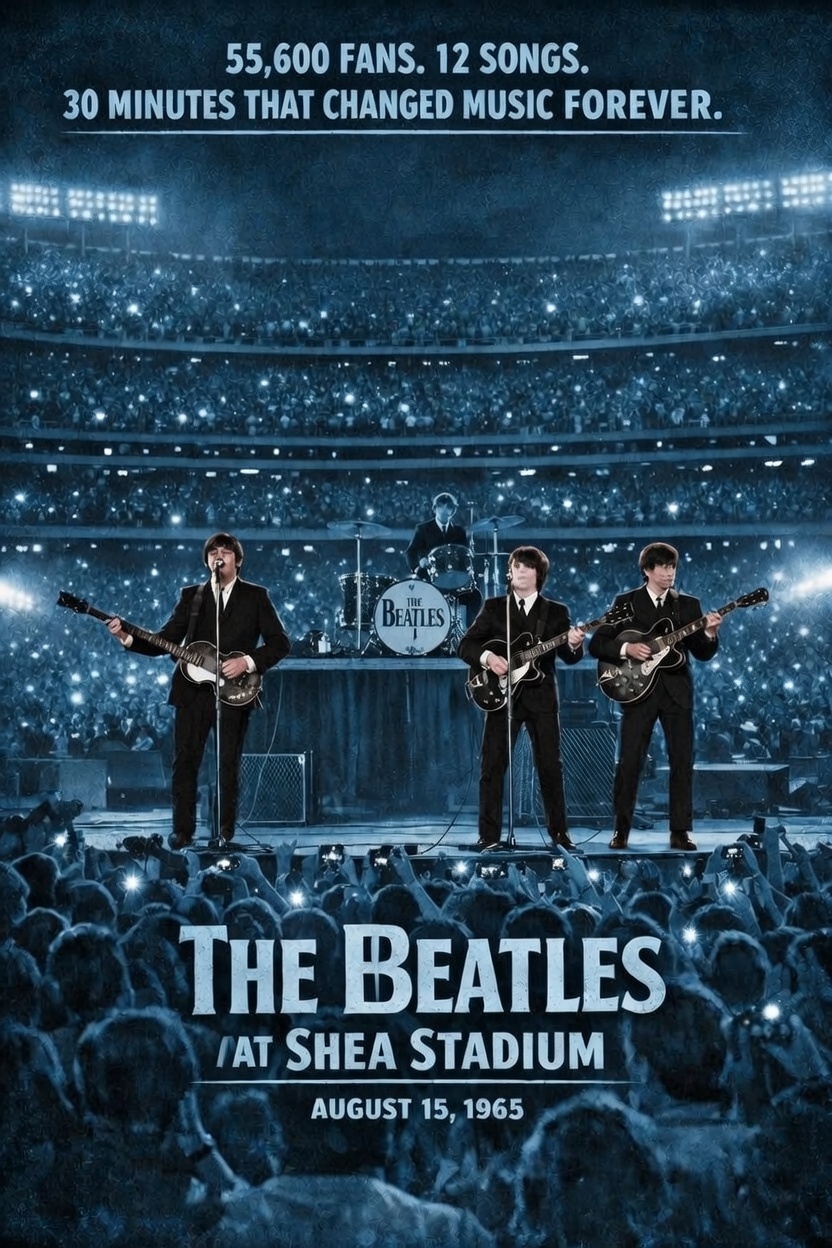
August 15, 1965. Shea Stadium, New York. The air didn’t just buzz with anticipation—it **vibrated** with a frequency no one had ever measured. 55,600 people, mostly young women, had not come to simply hear music. They had come to **witness a phenomenon**, to be part of a collective eruption. When The Beatles took the field, walking across the baseball diamond to a makeshift stage on second base, they weren’t just a band on a stage. They were astronauts on a new planet.
**The Chaos Was the Point**
The technical details are now legendary in their inadequacy: Vox amplifiers hopelessly underpowered, the sound system a distorted, tinny ghost of their music. The band couldn’t hear their own instruments over the tectonic-plate-shifting screams. Ringo Starr kept time by watching the bounce of John and Paul’s backs; they played by muscle memory and sheer faith. To the organizers, it was a terrifying, beautiful disaster—the fear that the sheer energy could literally bring the structure down.
But that chaos was the catalyst. Shea Stadium proved that the old rules of acoustics and audience decorum were obsolete. The performance wasn’t in the nuanced guitar lick or the harmonic blend; it was in the **shared, ecstatic experience**. The sound wasn’t in the speakers; it was in the **air itself**, a physical force of pure celebration.
**The Blueprint for Everything That Followed**
That 30-minute set didn’t just break records; it **invented a new architectural plan for popular culture.**
* **The Scale:** It proved that the emotional connection of rock ‘n’ roll could fill a space designed for tens of thousands. The stadium was no longer just for sports; it was a new cathedral for a secular age.
* **The Spectacle:** The event demanded a new kind of production—helicopter shots, massive stage setups, security logistics. The concert became a **total event**, as much about being seen there as hearing the music.
* **The Symbolism:** Four lads from Liverpool commanding a New York ballpark signaled a seismic shift in cultural power. Youth culture wasn’t a niche; it was the main event.
**The Ripple That Never Faded**
Every pyrotechnic blast at a Taylor Swift show, every laser cutting through a U2 stadium, every massive video screen at a Beyoncé concert, traces its lineage back to that humid night in Queens. Shea Stadium was the **proof of concept**. It was the moment the industry realized that the audience’s desire for collective joy was a force that could reshape the very spaces we gather in.
The Beatles didn’t just play a concert at Shea Stadium. They **performed the future**. They took 30 minutes of near-silent music, drowned in a roar of human electricity, and in doing so, drafted the blueprint for the next sixty years of live entertainment. Some moments aren’t just history. They are the **origin story**.