# **The Gamble at Golden Hour: How Freddie Mercury Engineered Queen’s Resurrection**
In the summer of 1985, Queen was not a band on the brink of a triumph. They were, by many measures, a band on the brink. Their latest album, *The Works*, had underperformed. A taxing world tour had left them exhausted and fractious. Rumors of a breakup weren’t just tabloid fodder; they were a real possibility discussed in weary tones. When the invitation for Live Aid arrived—a global telecast for Ethiopian famine relief—some within the camp saw it as a distraction. But Freddie Mercury saw something else: a **last chance**.
He saw a stage, an audience of billions, and a 20-minute window to rewrite their epitaph.
**The Prime-Time Gambit**
The now-legendary insistence on the **6:41 p.m. slot** was not mere diva behavior. It was a masterstroke of theatrical psychology, orchestrated by Mercury. His reasoning was cold, calculating, and brilliant:
* **The Golden Hour Audience:** It was the precise moment in the UK when the television audience would peak. The workday was over, families were home, and the colossal American audience was just tuning in. He wanted maximum impact.
* **The Dying Light:** Performing as dusk began to fall created a natural, dramatic atmosphere—neither the harsh afternoon sun nor the full cloak of night, but a moment of transformation.
* **A Statement of Belief:** Demanding the prime slot was a declaration. It told the organizers, the other bands, and Queen themselves: *We are not a nostalgia act. We are the event.*
**Behind the Curtain: The 20-Minute Ultimatum**
Internally, the pressure was immense. This wasn’t just another gig. It was a potential very public funeral for a fading empire. They had one shot. Rehearsals were stripped down, ruthless, and focused not on perfection, but on **pure, communicative power**. Mercury pared down the setlist to an undisputable greatest hits package: “Bohemian Rhapsody,” “Radio Ga Ga,” “Hammer to Fall,” “Crazy Little Thing Called Love,” “We Will Rock You,” “We Are the Champions.”
His instruction was simple: *“Forget the album. Forget being clever. Play every song like it’s the last time anyone will ever hear it.”*
**The Performance That Changed Everything**
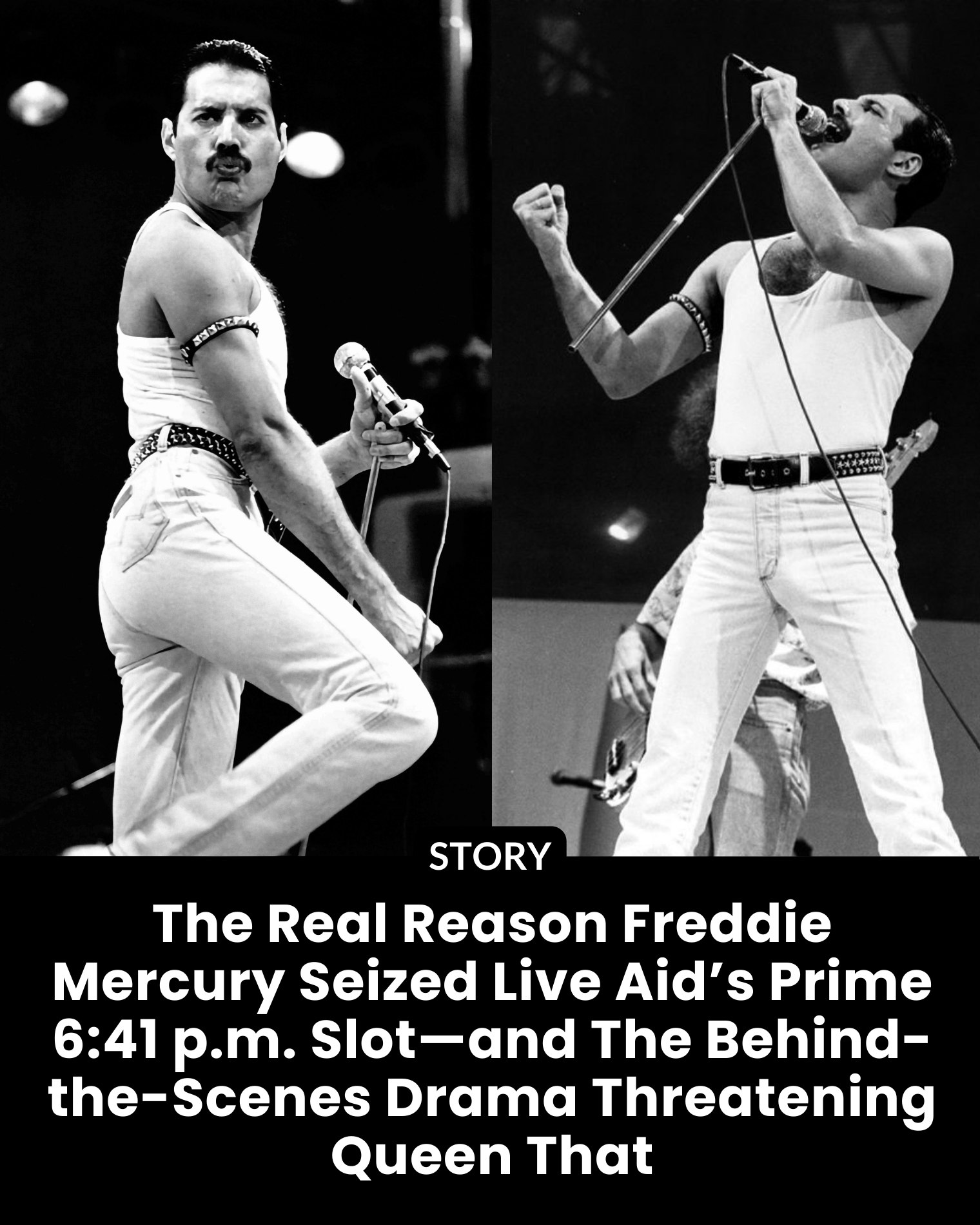
What happened at 6:41 p.m. on July 13, 1985, was not a performance; it was a **hostile takeover of a global stage**. In twenty minutes, Mercury didn’t just sing—he conducted a stadium of 72,000 and a television audience of 1.9 billion like a single instrument. The call-and-response of “Ay-Oh” was a stroke of genius, instantly forging an intimate bond on a colossal scale. Every movement was grand yet utterly committed; every note was a reclaiming of territory they were in danger of losing.
The drama that threatened them—the fatigue, the commercial doubt, the internal strain—was vaporized in the white heat of that set. By 7:01 p.m., Queen was no longer a band in decline. They were **immortal**.
Live Aid didn’t just save Queen’s career; it crystallized their legend. It proved Freddie Mercury’s ultimate thesis: that image, sound, and timing could be weaponized into a force of nature. He didn’t just seize a time slot; he seized a moment in history and, with a piano, a microphone, and sheer will, bent it irrevocably to his own magnificent design. The breaking point became the launching pad for eternity.