The Boy Who Held His Breath: The Education of Farrokh Bulsara
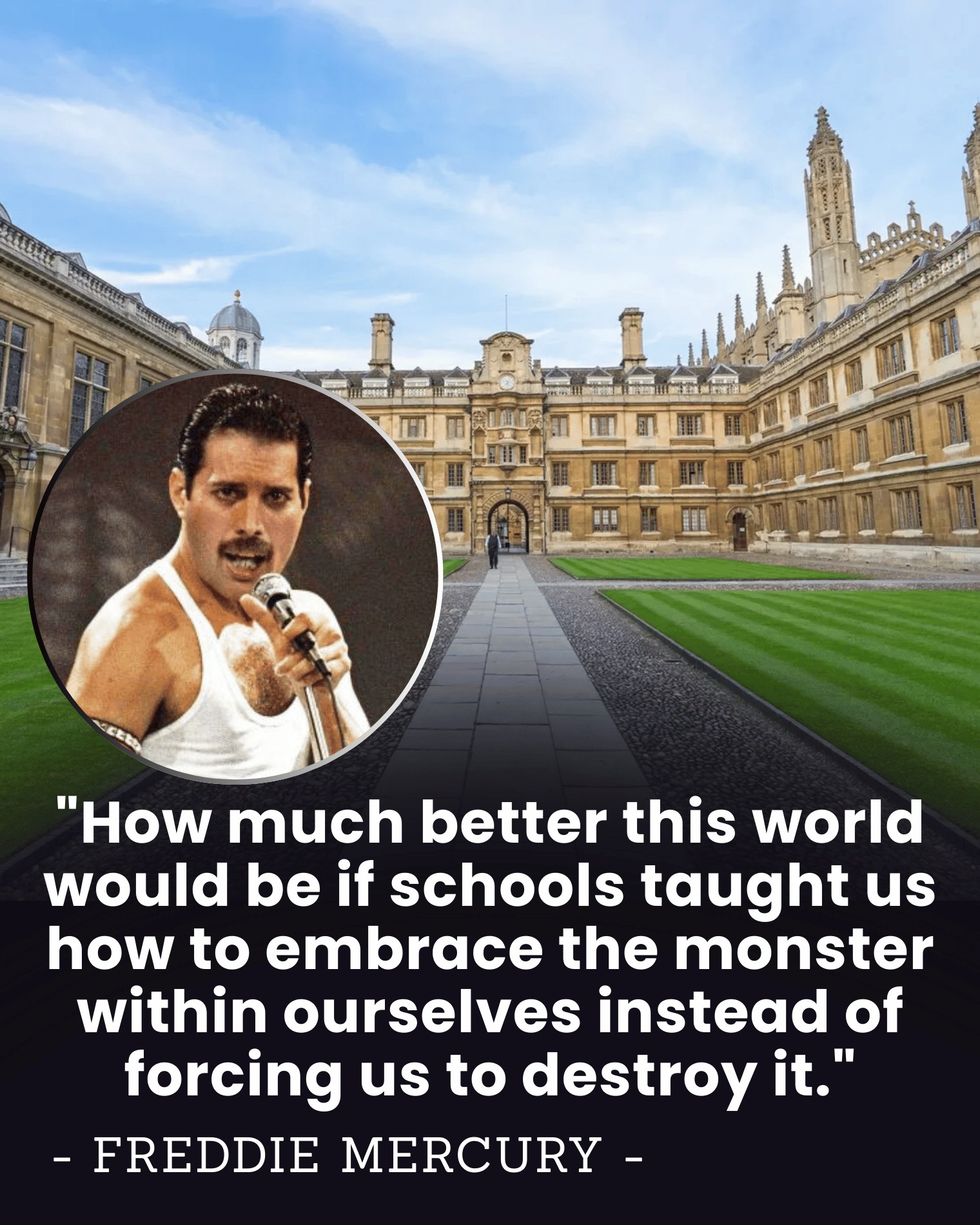
Before the leotard, before the crown, before the note that could shatter glass, there was a small, sensitive boy with an overbite and a suitcase too heavy for his frame. His name was Farrokh Bulsara, and at eight years old, he was sent from the warmth of Zanzibar to the rigid, rain-chilled discipline of an English boarding school in Panchgani, India.
Here, difference was not a gift; it was a liability. His Zoroastrian faith, his Persian features, his emerging artistic flair—all were marks to be sanded down. The system was engineered to produce uniformity, and Farrokh’s innate **sensitivity**, his love for piano and sketching, his quiet observation, became his first secret. To survive, he learned to perform a different self: to box, to play cricket, to fold his flamboyance into a drawer and turn the key.
This was the foundational silencing. It wasn’t just about hiding his future sexuality; it was about learning that the very depth of feeling that would one day connect him to millions was, in this world, a weakness to be concealed. His voice, which would become the most instrumentally expressive in rock, learned its first lesson: to be careful.
The cost was a profound internal rift. The boy who would become Freddie Mercury spent his formative years mastering a double life. The flamboyant performer was forged in the furnace of repression, not in spite of it, but **because** of it. Every suppressed mannerism, every stifled creative impulse, gathered like a coiled spring. The stage would later become the place where that spring could finally, catastrophically, gloriously uncoil.
His story is more than a rock legend’s origin. It is a haunting case study in what traditional education can silence when it values conformity over character. It asks what genius is lost when we teach children to camouflage their true textures.
Freddie’s ultimate reclamation was not a gentle unfolding, but a volcanic eruption. He didn’t just find his voice; he built a cathedral for it, note by defiant note. He took every trait that school taught him to hide—the drama, the sensitivity, the sheer, unapologetic *otherness*—and weaponized them into art. He became the ultimate supernova, a blinding testament to the fact that what we are taught to suppress often contains the very core of our power.
The journey from Farrokh to Freddie is the story of a soul in exile, returning home at full volume. It is a permanent reminder that the world often tries to educate the uniqueness out of us, and that the greatest act of a lifetime can be to spend it giving that silenced child a microphone, a spotlight, and the roaring approval of the world.