The Sonic Riot: The Night The Beatles Played a Perfect Set in Total Silence
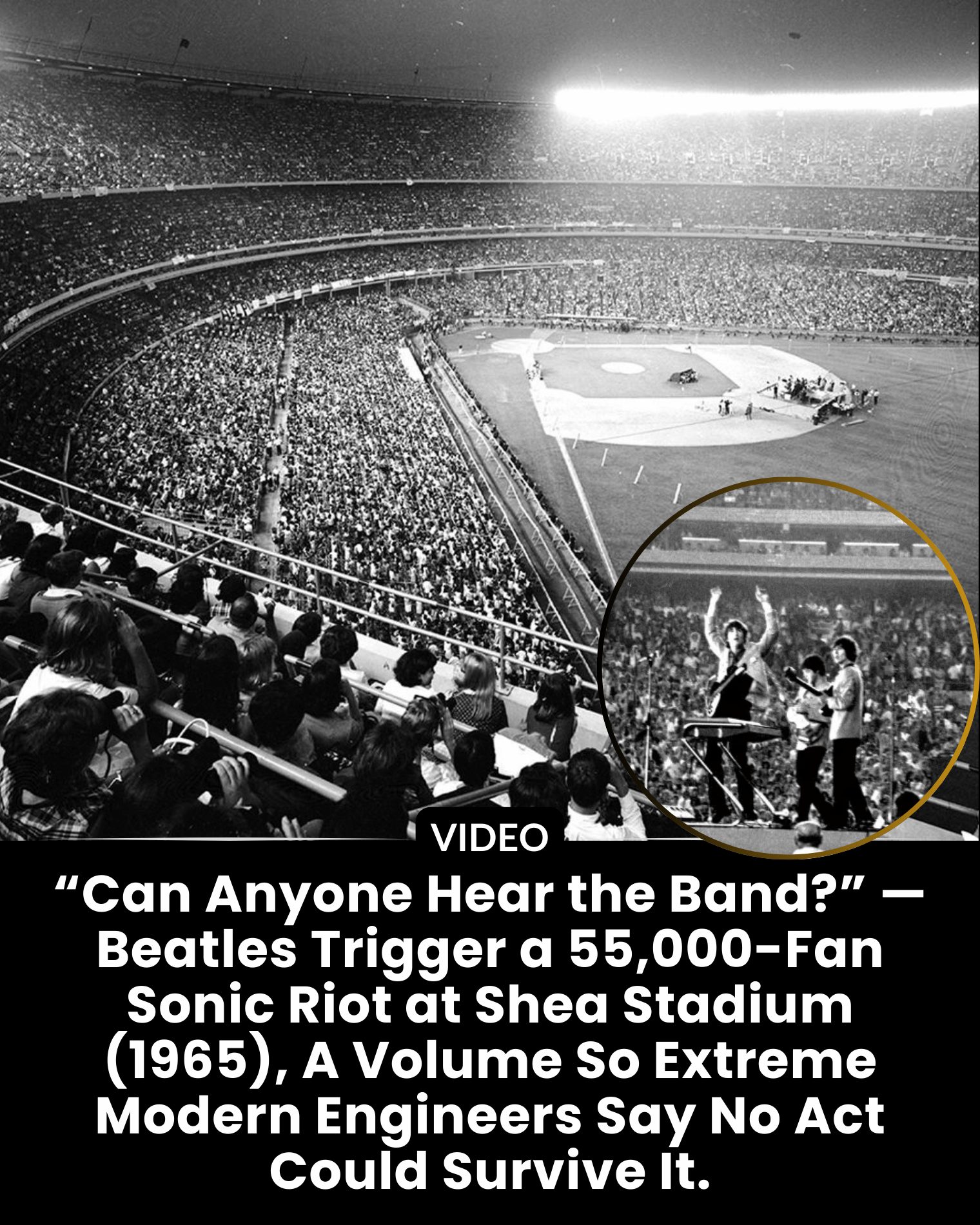
It was not a concert. It was a **mass acoustic event** that defied the very physics of performance. On August 15, 1965, at Shea Stadium, 55,000 voices—mostly young, mostly screaming—did not accompany The Beatles. They **drowned them.** The sound was measured later not in decibels, but in comparison: a **constant, rolling sonic wave equivalent to a jet engine at takeoff,** peaking at an earth-shaking **115 decibels.**
On the flimsy, pitcher’s mound stage, John, Paul, George, and Ringo were thrust into an unprecedented sensory vacuum. Their Vox amplifiers, state-of-the-art for clubs, were **sonic teacups in a hurricane.** They couldn’t hear their guitars, their drums, or most terrifyingly, their own voices. The monitor speaker, a solitary sentinel, was a useless artifact—its output swallowed whole by the tsunami of screams before it traveled two feet.
**They were playing in total, absolute silence.**
What followed was not a musical performance, but a **feat of neuromuscular memory and telepathic will.** The Beatles did not *hear* “Twist and Shout”; they *remembered* it in their hands, their lungs, their limbs. They played by **vibrational intuition**—feeling the thump of Ringo’s kick drum through the wooden stage planks, locking eyes to guess the chord changes, singing on pure adrenaline and muscle memory of a thousand prior performances. It was a live-action replay of a recording only they could remember.
Modern sound engineers and physiologists state flatly: **no modern act could, or would, endure this.** Today’s in-ear monitors, which pipe a perfect mix directly to a performer’s ears, would be instantly overloaded and useless. The psychological disorientation—the complete severing of the feedback loop between action and sound—would cause any contemporary musician to stop, confused and terrified. The hearing damage alone would be catastrophic and immediate.
Yet, The Beatles played a **twelve-song set.** It was, by their own admission, a messy, out-of-tune, frantic affair. But it was also **perfect.** Perfect because it happened at all. Perfect because in that chaotic void, they discovered a different kind of connection: a raw, visual, electric communion with a sea of faces expressing a joy so intense it had become a physical force.
The Shea Stadium concert was not the peak of their musical prowess. It was the **outer limit of their cultural phenomenon.** It proved that “Beatlemania” wasn’t just fandom; it was an environment capable of altering the fundamental conditions of performance. They weren’t just surviving a sonic riot; they were conducting it, riding a wave of pure energy that had long since left the realm of music and entered the realm of history.
The question wasn’t *”Can anyone hear the band?”*
The truth was, in that moment, **the band was the only thing not making a sound.** And in that silent center of the hurricane, they played on, writing the definitive rulebook on how to perform the impossible.