1974: The Night Queen Invented the Blueprint for Thrash Metal
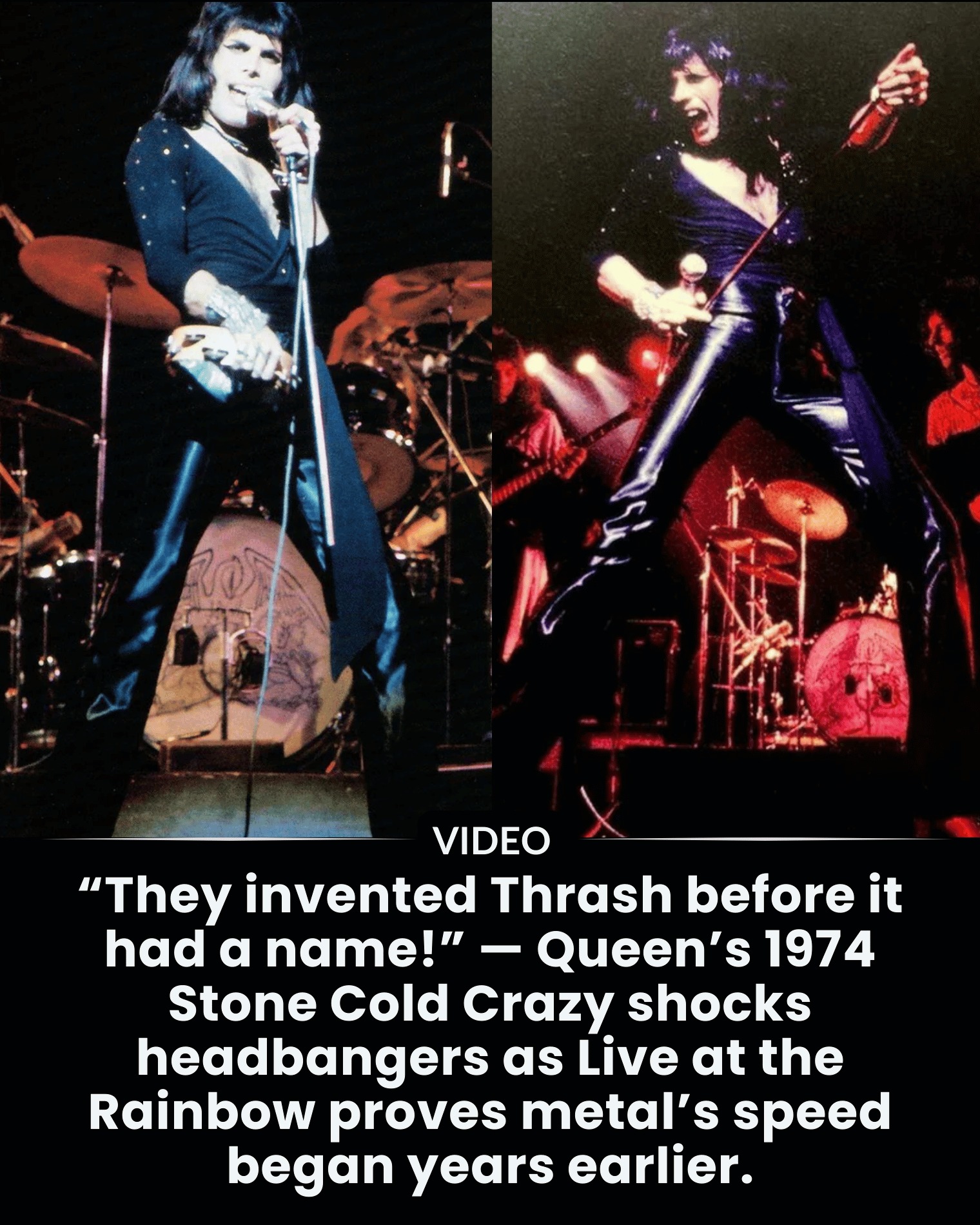
In the annals of rock history, 1974 is remembered for the birth of arena rock, the peak of glam, and the early rumblings of punk. But on a single night at London’s Rainbow Theatre, **Queen** did something that would quietly detonate the future of heavy music.
The song was **“Stone Cold Crazy.”** A track from their third album, *Sheer Heart Attack*, it already stood out on vinyl—a two-minute, twenty-second blast of paranoia and speed. But live, it mutated into something else entirely.
From the moment Brian May’s searing, staccato riff tore through the hall, the rules changed. There was no grandiose opera here. This was **pure, uncut velocity.** Roger Taylor’s drums weren’t just keeping time; they were a relentless, chaotic assault, a proto-blast beat years before the term existed. Freddie Mercury didn’t sing the lyrics so much as **spit them** with a snarling, gritty aggression miles away from his trademark soaring theatrics. The tempo wasn’t just fast; it was **frantic**, a dizzying rush that felt on the verge of collapsing under its own manic energy.
The audience that night, expecting the sophisticated layers of “Killer Queen” or the epic scope of “Liar,” was blindsided. This wasn’t a song to sway to; it was a song to **survive.** It felt less like a performance and more like a demolition.
In that raw, ferocious two minutes, Queen—the band of four-part harmonies and baroque piano—**unwittingly laid down the DNA for thrash metal.** Every essential element was there: the breakneck speed, the razor-sharp, palm-muted riffing, the aggressive, almost shouted vocals, the lyrical themes of societal breakdown. They had built the rocket. They just didn’t stick around to launch the mission to Mars.
It would take another decade for the kids in San Francisco’s Bay Area and New York’s underground—kids like Metallica, who would famously cover “Stone Cold Crazy” on their 1991 *Metallica* album—to find that blueprint, amplify its aggression, and codify it into a genre called thrash.
But the fuse was lit in 1974. On a London stage, amidst the glitter and glam, four musical savants proved that aggression and complexity weren’t opposites, and that speed could be a weapon of its own. They didn’t just play a fast song.
They prophesied a revolution, and left the manual on the stage for a generation of headbangers to find.