# **The Call from the Mountain: How Montserrat Caballé Gave Freddie Mercury a New Voice**
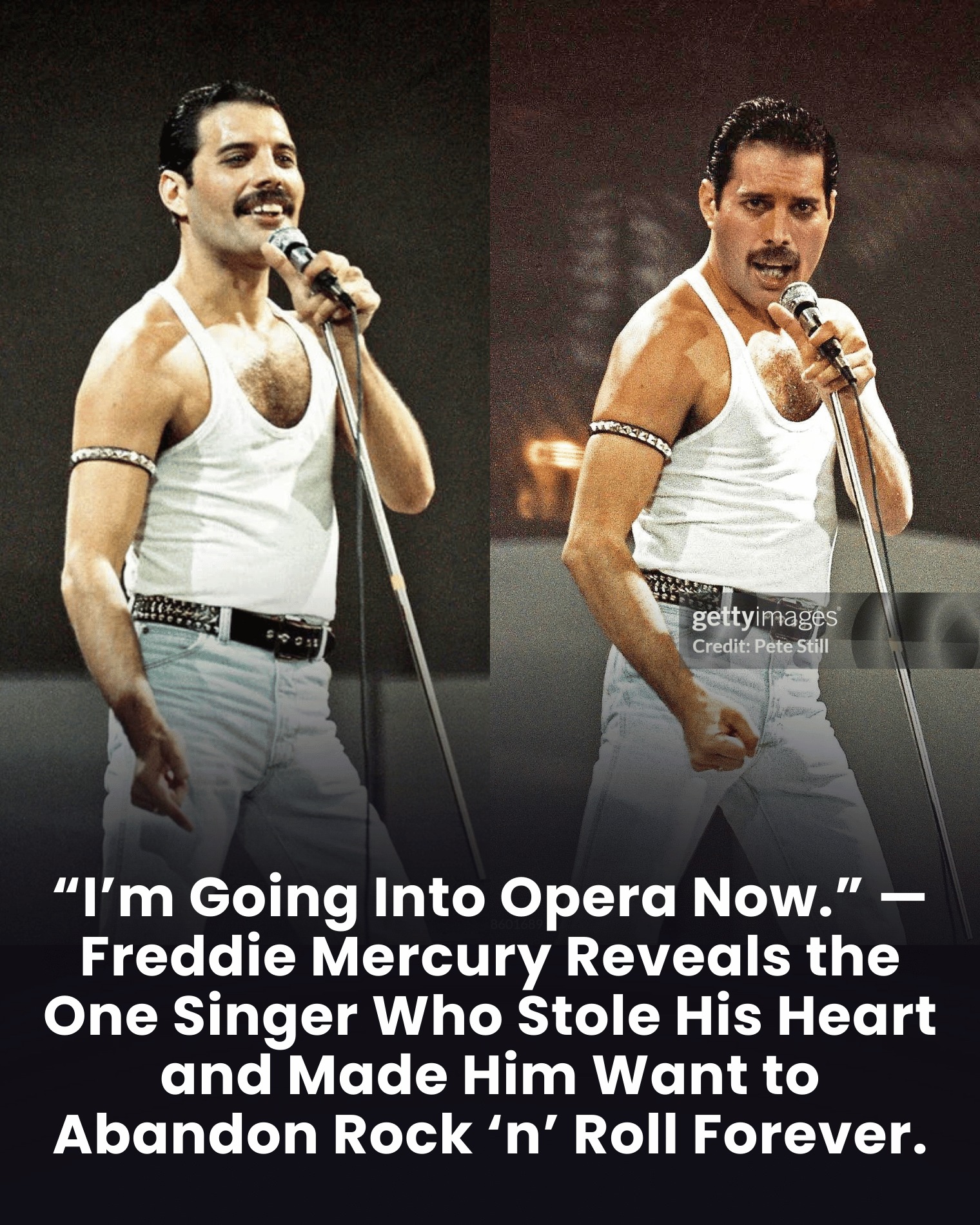
In the mid-1980s, at the very zenith of his rock godhood, Freddie Mercury arrived at a creative precipice. Queen had conquered stadiums, but the formulas were becoming familiar. Then, he heard a voice that, by his own account, made everything else seem obsolete: the legendary Spanish soprano, **Montserrat Caballé**.
The story goes that after hearing her sing, Mercury—rock’s most flamboyant and seemingly self-assured frontman—turned to his friends and declared, with awe and finality: ***”Rock and roll is finished.”***
It was not a statement of defeat, but one of **artistic revelation**. He had encountered a level of vocal technique, emotional purity, and sheer, untamed power that transcended genre. In that moment, the ultimate rock star understood he was still a student. This meeting would catalyze the final, glorious evolution of his artistry.
### **The Daring Collaboration: “Barcelona”**
Their collaboration was unprecedented. It wasn’t a rock star featuring an opera singer for novelty; it was a **genuine duet between equals** from seemingly alien musical worlds. The project, spearheaded by Mercury for the 1992 Olympic Games in Caballé’s hometown, demanded everything of him.
For Mercury, working with Caballé was a return to his first love—the piano, melody, and classical structure—but now infused with a lifetime of rock theatricality. He composed not guitar riffs, but **arias for two voices**. He had to write for a vocal instrument whose range, sustain, and nuance far exceeded the demands of even the most demanding rock anthem. The title track, “Barcelona,” is a masterpiece of this fusion: a rock-orchestral swell built for a soprano’s celestial peaks and a rock tenor’s passionate, raw power.
### **Rewiring a Legacy**
This collaboration fundamentally rewired Mercury’s approach to his own voice and Queen’s music in his final years.
1. **The Pursuit of Purity:** After years of grit, distortion, and layered harmonies, he began to value **clarity and naked emotion** in his vocal delivery. You can hear this in the poignant, stripped-back vulnerability of “The Show Must Go On” and much of the *Innuendo* album.
2. **Orchestral Ambition:** It validated and magnified the latent classical ambition always present in Queen’s music, from “Bohemian Rhapsody” onward. The success of “Barcelona” emboldened the band’s use of orchestral arrangements on their final albums.
3. **Artistic Peerage:** For Mercury, earning the respect and friendship of Caballé was a profound validation. It placed him in a **different artistic lineage**—not just as a rock icon, but as a serious composer and vocalist who could hold his own on the world’s most prestigious stages.
### **The Poignant Race Against Time**
The tragedy and beauty of this chapter is its timing. This creative rebirth occurred just as Mercury’s health was declining. The “Barcelona” album was released in 1988, and their iconic performance of the title track at the 1987 Ibiza festival would be one of his last major public appearances. He was pouring his refined artistry into a vessel that was running out of time.
The collaboration with Montserrat Caballé did not mark the end of rock and roll for Freddie Mercury. It marked the moment he **transcended it**. He took the raw power of rock, fused it with the disciplined grandeur of opera, and created something timeless. In seeking a new mountain to climb, he found a new summit for his own voice, proving that even the wildest frontman could become a classical student, and in doing so, compose the most dignified and moving curtain call in rock history. The student had, once again, become the master.