The Hyde Park Rhapsody: 65,000 Strangers Become a Single Voice for Freddie
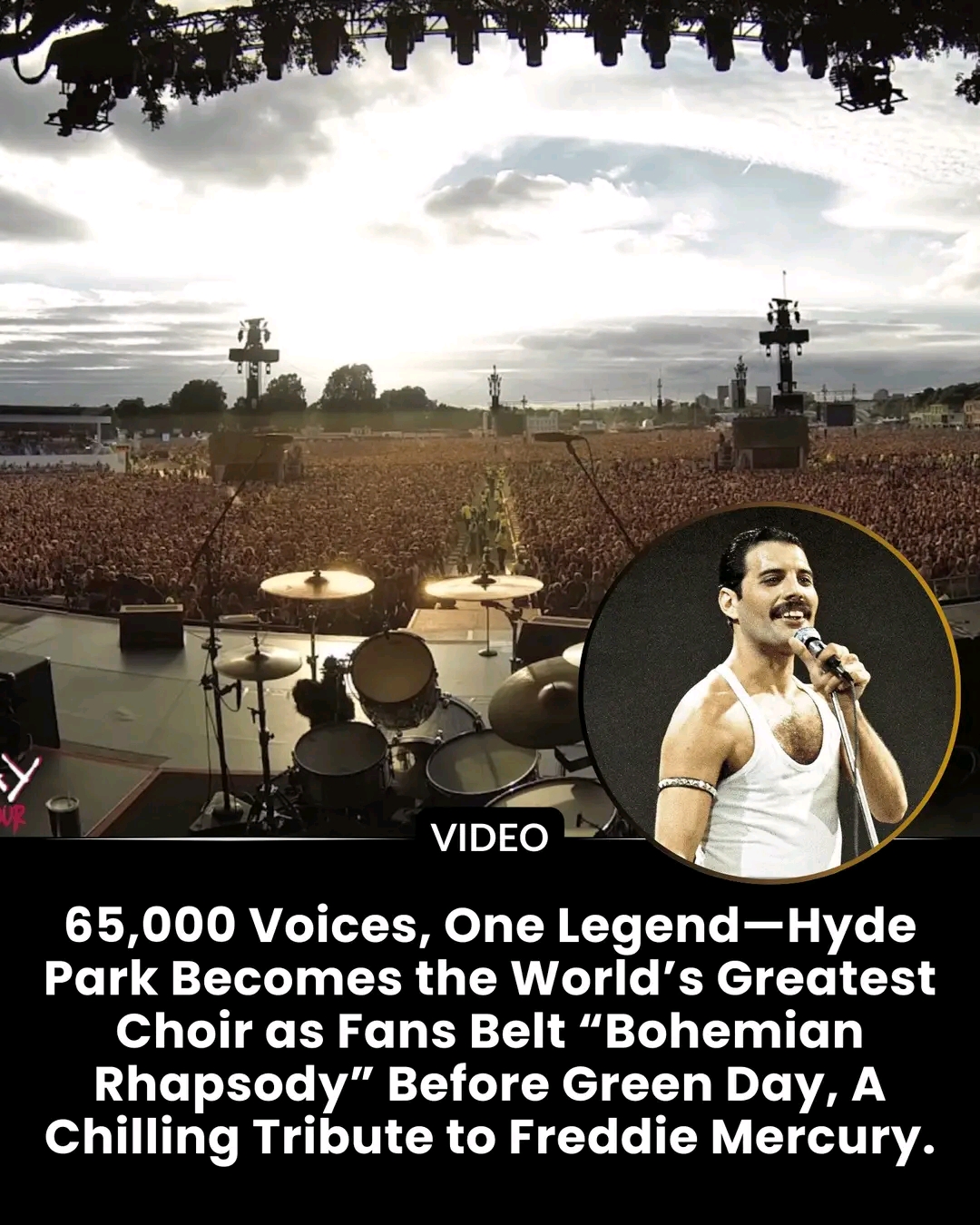
On a summer evening in London’s Hyde Park, history didn’t just repeat itself—it harmonized. The stage was set for Green Day, the punk-pop giants of a later generation. But in the anticipatory lull before the headliner, as the sun dipped and the sound system played a classic rock playlist, a different, more profound headline act took the stage: the crowd itself.
The first, iconic piano notes of Queen’s “Bohemian Rhapsody” rang out over the sea of 65,000 people. What happened next was not the usual murmur of recognition or a few fans singing along. It was a spontaneous, organic ignition. One voice from the stands was joined by another, then a hundred, then ten thousand. Section by section, without a conductor or a cue, the entire massive crowd morphed into a single, colossal choir.
The Anatomy of a Viral Miracle
For the next six minutes, 65,000 strangers, from teenagers in Green Day shirts to parents who lived through Queen’s heyday, performed a masterpiece in perfect, passionate unison.
· The Ballad: They sang the tender, heartbreaking opening verses (“Is this the real life? Is this just fantasy?”) with a surprisingly gentle, collective focus.
· The Opera: As the song spiraled into its surreal, multi-tracked operatic middle section, the crowd didn’t falter. They became a human synthesizer, tackling the intricate harmonies of “Galileo,” “Figaro,” and “magnifico” with a joyful, shouting precision. It was less about perfect pitch and more about sheer, committed force of will.
· The Hard Rock: When Brian May’s iconic guitar riff exploded into the heavy rock finale, the park erupted. 65,000 fists pumped the air in time, voices roaring “So you think you can stone me and spit in my eye?” with a unified, cathartic fury.
· The Outro: The song faded on its final, haunting piano chord (“Any way the wind blows…”), and for a brief, suspended moment, a roar of their own creation—a mix of cheers, laughter, and tearful disbelief—replaced the music. They had done it.
Why This Moment Transcended
This was more than a crowd singing a classic rock song. It was a cultural séance and a testament to music’s timeless, unifying power.
1. A Tribute That Needed No Announcement: This wasn’t a planned memorial or a concert segment. It was a pure, audience-driven tribute to Freddie Mercury, proof that his spirit and musical genius are woven so deeply into the fabric of global culture that they can resurrect him spontaneously, anywhere.
2. Generational Alchemy: The crowd was primarily there for Green Day, a band born from the 1990s punk scene. Yet, a 1975 progressive rock opera became their shared anthem. It proved that great music erases generational divides, creating a common language where a 16-year-old and a 60-year-old can find the same emotional truth.
3. The Ultimate Crowd-Sourced Art: In an age of curated playlists and algorithmic feeds, this was a raw, human-made moment. It was the sound of collective memory and shared joy asserting itself over programmed entertainment.
The viral videos captured more than sound; they captured faces—eyes closed in concentration, arms around friends’ shoulders, mouths wide open in full-throated joy. It was the visible proof of music’s true purpose: connection.
When Green Day finally took the stage minutes later, they were playing to a crowd already electrified by its own power. Billie Joe Armstrong and the band were likely the only people in Hyde Park not singing every word minutes before. The “Hyde Park Rhapsody” stands as a perfect, unprompted monument. It declared that the greatest stage is sometimes the one without a performer, and the most powerful voice is the one made of 65,000 others, united in a song that, truly, will never die. Freddie Mercury would have loved it. In a way, through every single voice, he was there.pi