# **The 20-Minute Miracle: How Freddie Mercury’s Live Aid Gamble Defied Physics and Redefined Rock**
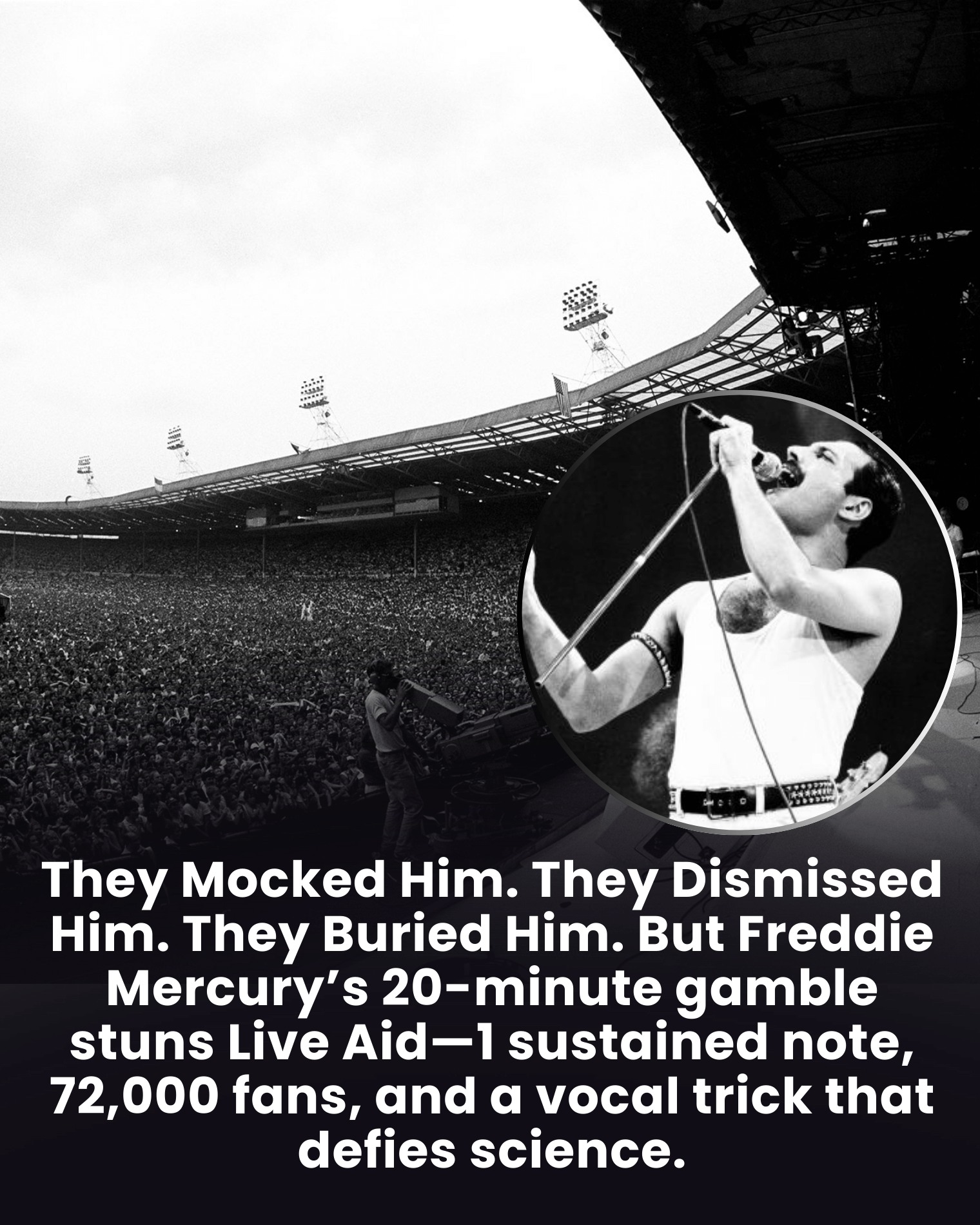
On July 13, 1985, the narrative around Queen was one of fading glory. Critically panned, commercially wobbly, and fractured by solo projects, they were not the headliners of Live Aid—they were an afterthought, a heritage act slotted into the late-afternoon lineup at Wembley Stadium. When Freddie Mercury walked onto that stage at 6:41 PM, he wasn’t just facing 72,000 people and a global television audience of nearly two billion. He was facing obsolescence.
He took it all in with a single, sweeping look. And then, with no grand introduction, he made a **reckless, perfect gamble.**
### **The Anatomy of a Gamble**
The stakes were operatic in scale, the preparation minimal. Queen had no time for a proper soundcheck on the custom-built stage. They had precisely **20 minutes** in an era defined by 15-minute MTV clips. Their setlist was a strategic masterstroke—six anthems, no ballads, a relentless barrage of hits designed for maximum impact: “Bohemian Rhapsody,” “Radio Ga Ga,” “Hammer to Fall,” “Crazy Little Thing Called Love,” “We Will Rock You,” “We Are the Champions.”
But the true gamble wasn’t the songs; it was **trusting pure, unamplified human connection** in an age of growing studio artifice.
### **The Alchemy of Command**
Mercury’s first act was one of silence. He stood at the lip of the stage, gripping a microphone sawn in half to look like a scepter, and simply **listened** to the roar. Then, he began to conduct it.
With a raised fist and two syllables—***”Ay-Oh!”***—he performed a feat of mass psychology. He tuned the crowd like an instrument, turning 72,000 disparate voices into a unified, harmonic choir. This was not singing along; this was **sonic submission.** He proved he could command the stadium without singing a single note of a song.
Then came the sustained note. During “Hammer to Fall,” as he belted the line “*And we’re just waitin’ for the hammer to fall,*” he held the final “*fall*” not for a beat, but for what felt like an eternity—a **raw, unwavering blast of power** that cut through the open-air mix with the clarity of a diamond. It was a vocal feat that seemed to defy lung capacity and vocal cord physics, a declaration of undiminished might.
### **The Science of the Sublime**
What “stunned science” was not just the technical prowess, but the **biomechanical and psychological perfection** of the performance under such conditions.
* **Vocal Physiology:** To produce such sustained power after years of taxing his instrument, without warming up on the very stage, demonstrated near-supernatural control over his diaphragm and support muscles. Speech scientists and vocal coaches still point to it as a benchmark of efficient technique under extreme duress.
* **The “Third-Voice” Phenomenon:** Analysts have noted that in the harmonies, particularly during “Bohemian Rhapsody,” Mercury’s live voice seemed to create a **phantom third harmony** with the pre-recorded backing tapes, a sonic illusion of a choir emerging from one man.
* **Crowd Synchronicity:** The timing of his call-and-response was so intuitive it created a feedback loop of energy. Sociologists study it as a case of perfect crowd orchestration, where a leader doesn’t just direct a mob but aligns it into a single, conscious organism.
### **The Rewriting of History**
In 20 minutes, the narrative was obliterated. Queen didn’t just play Live Aid; they **consumed it.** The performance became the absolute yardstick against which all live rock would henceforth be measured. It proved that in the digital future, the most potent technology would remain a human being at the peak of their expressive power, connecting viscerally with other human beings.
The gamble paid off in perpetuity. Overnight, Queen transformed from a band past its prime into **immortal legends.** Live Aid didn’t revive their career; it crystallized their myth. Freddie Mercury, written off as irrelevant, walked onto that stage and didn’t just give a performance. He conducted a masterclass in charisma, authored a textbook on vocal command, and, with one sustained note and 72,000 voices under his spell, permanently rewrote the very definition of what a live music moment could be. It was the day a underdog didn’t just win—he changed the game forever.