# The Locked Cupboard Coup: How a Prank Made Roger Taylor a “Bohemian” Millionaire
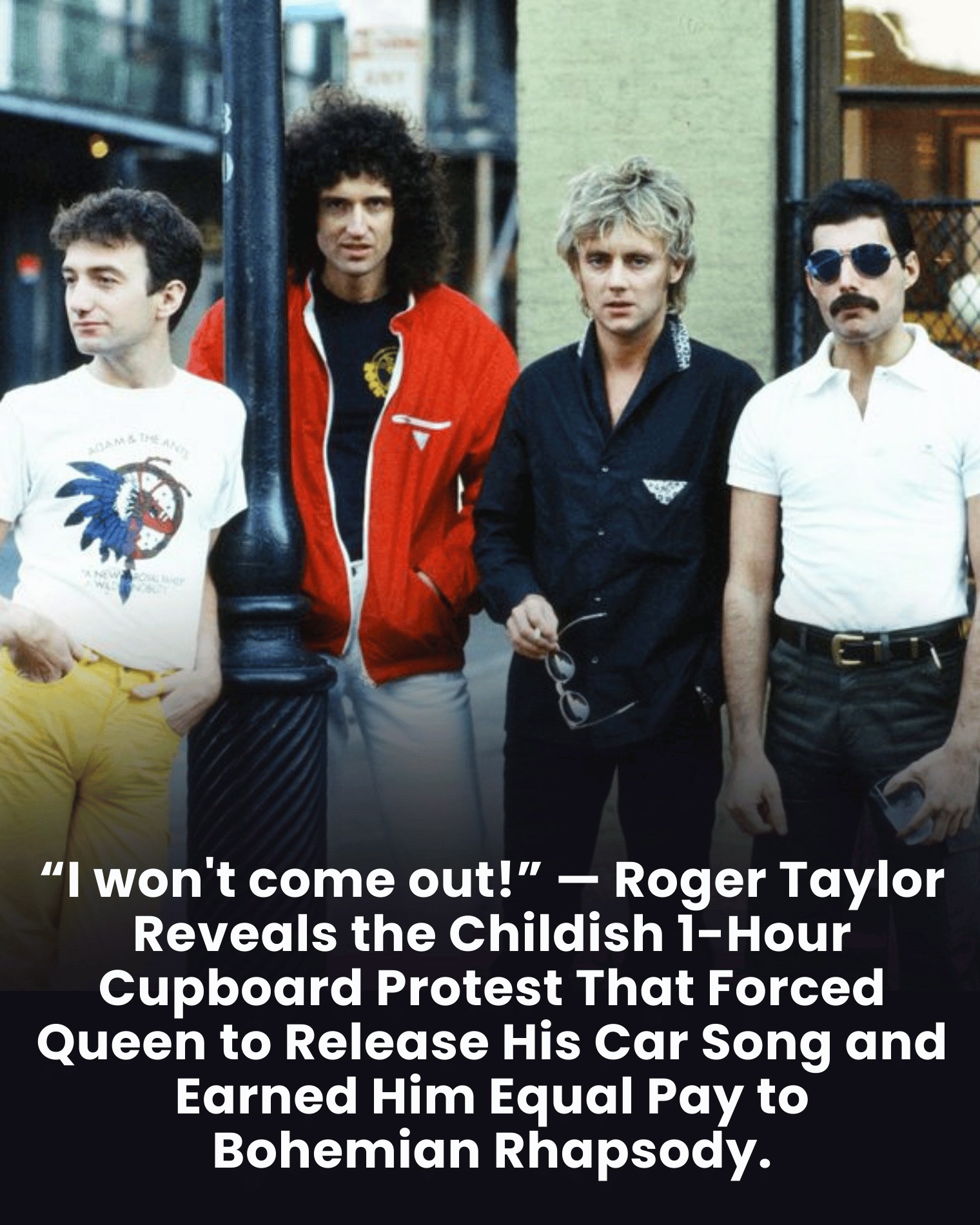
The story is the stuff of rock legend, a perfect blend of pettiness, principle, and spectacularly accidental profit. In 1975, as Queen prepared to release their magnum opus, **”Bohemian Rhapsody,”** a petty yet brilliant protest by drummer Roger Taylor would forever alter the financial legacy of the band’s most famous song.
### The Petty Protest
Queen’s label, EMI, and their producers were deeply skeptical of “Bohemian Rhapsody.” At nearly six minutes with no chorus and an operatic middle section, it broke every rule for a successful single. The band was told it was too long, too weird, and would never get radio play. A huge fight ensued.
The band, especially the song’s primary creator Freddie Mercury, refused to cut a single second. As a compromise, it was decided the single’s B-side would be a surefire, radio-friendly rock track to entice DJs. The choice landed on **”I’m in Love with My Car,”** a roaring, tongue-in-cheek ode to automobiles written and sung by Roger Taylor.
Taylor, however, was furious. He felt his song was being used as a sacrificial lamb to a cowardly label, demeaning its value. In a fit of glorious, rock-star pique, he staged his protest: **he locked the master tape of “I’m in Love with My Car” in a cupboard and refused to hand it over.** For a tense hour, the release of what would become one of history’s greatest singles was held hostage by a drummer and a tantrum over his B-side.
### The Negotiation That Changed Everything
To break the stalemate and get the single out, a deal was struck. Roger Taylor, according to band lore, demanded a guarantee: in exchange for surrendering the tape, **the publishing rights and songwriter royalties for “I’m in Love with My Car” would be his and his alone.**
In the standard Queen arrangement, songwriting royalties were split among the four members, regardless of who wrote the song. This deal broke that mold. More importantly, as part of the negotiation, Taylor reportedly secured another, less-heralded clause: **his B-side would earn the *same mechanical royalty rate* as the A-side.**
### The Accidental Fortune
This technical clause is where the petty protest became a multi-million-dollar masterstroke. “Bohemian Rhapsody” wasn’t just a hit; it became a cultural monolith. It recharted multiple times, most famously in 1991 after Freddie Mercury’s death and again with the 2018 biopic, selling tens of millions of copies worldwide.
Every single one of those sales included “I’m in Love with My Car” on the flip side. Due to that negotiated royalty parity, **for every penny earned by “Bohemian Rhapsody” from record sales, Roger Taylor earned an equal penny for “I’m in Love with My Car.”** His three-minute joke about his Triumph TR4 was, by contract, valued the same as Freddie Mercury’s six-minute rock opera.
While Mercury (and later his estate) earned vastly more from the *publishing* of “Bohemian Rhapsody” as its writer, Taylor’s share of the *recording* royalties from the single’s sales became one of the most lucrative B-side deals in music history. It is estimated to have earned him **tens of millions of pounds** over the decades.
Thus, Roger Taylor’s locked cupboard protest stands as a legendary act of rock ‘n’ roll pettiness with an unimaginable payoff. He fought for the respect of his song about a car and, in doing so, secured a financial ride that has outlasted any automobile, proving that sometimes the most rock ‘n’ roll thing you can do is read the fine print—right after you’ve thrown a fit.