# **The Final Frame: How Freddie Mercury’s Black-and-White Goodbye Mastered His Own Image**
By early 1991, the world was whispering, but Freddie Mercury was done hiding. For the music video to “These Are the Days of Our Lives,” a nostalgic ballad on Queen’s final album *Innuendo*, he made a single, poignant demand of director Rudi Dolezal: **film it in black and white.**
The request was not an artistic whim. It was the last, calculated act of a man who had spent a lifetime commanding how he was seen. Frail and visibly ill from AIDS, he understood the cruel focus of the color camera lens. The high-definition gaze would have highlighted every shadow of his struggle, every trace of the illness he kept fiercely private. Black and white was his armor. It softened. It abstracted. It transformed a document of illness into a **poem of memory**.
### The Performance That Defied Reality
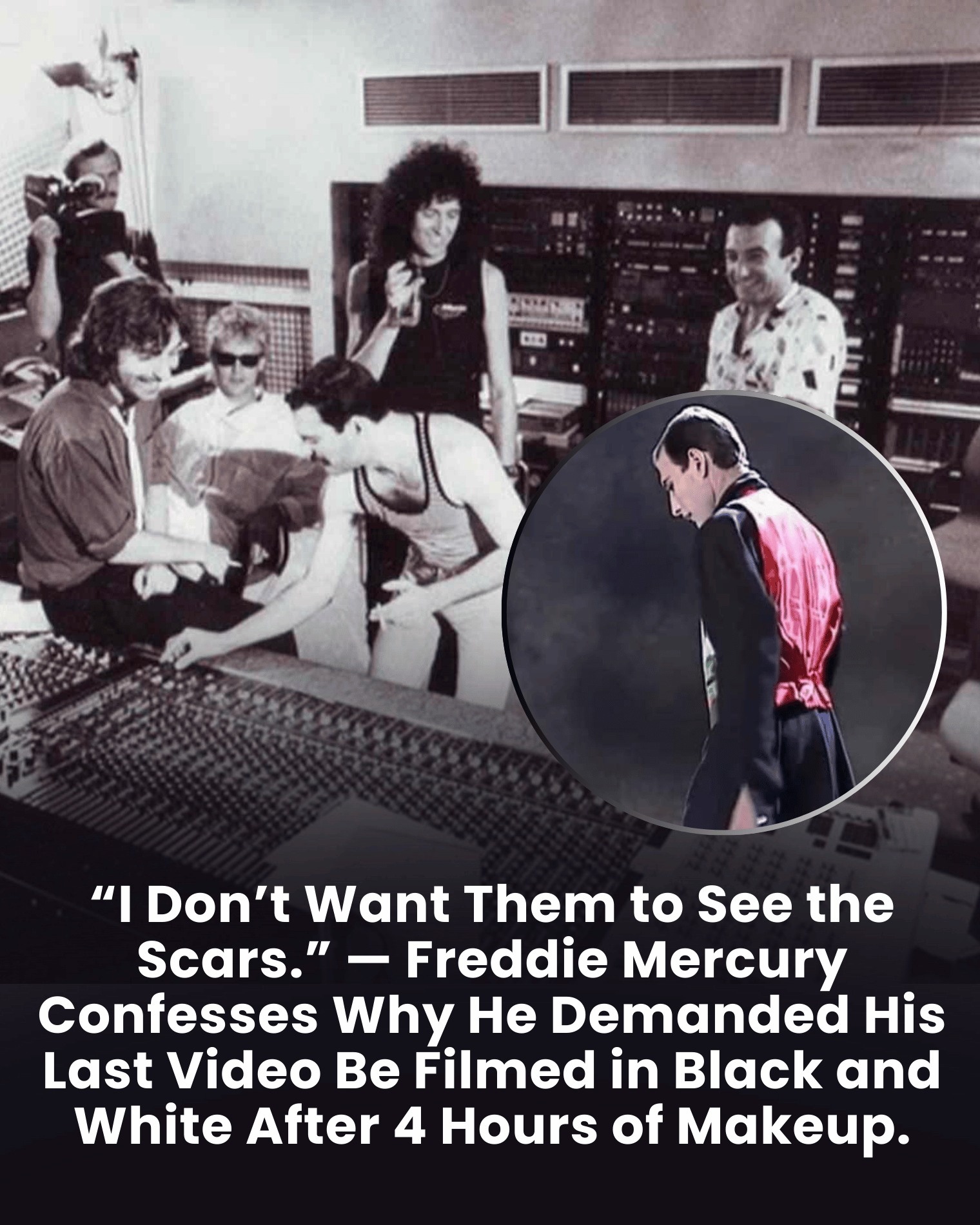
On set at Pinewood Studios, the effort was Herculean. He arrived cloaked in a silk robe, hours of makeup applied to give the illusion of the vibrant face the public remembered. But no makeup could restore the lost weight or the profound fatigue. And so, he channeled everything into his eyes.
In the video, dressed in a satin jacket embroidered with a whimsical cat motif, he moves slowly. He holds a prop, a small ball of light, with delicate reverence. His performance is not one of the rock god who stormed Live Aid, but of a **philosopher-king in his final court**, reflecting on a life spectacularly lived. The black-and-white film elevates it, giving the scene a timeless, ghostly quality—as if he is already half a memory, singing to us from the other side of a veil.
### The Look That Said It All
The moment that etches itself onto the heart comes at the very end. The song fades. Freddie turns fully to face the camera, breaking the “fourth wall” completely. He offers a small, knowing, almost mischievous smile—a fleeting glimpse of the old Freddie. Then, his expression softens into something unbearably tender and final.
He doesn’t speak. He simply **looks**. He holds the camera’s gaze, and by extension, the gaze of every future viewer, in a silent communion that lasts just a few seconds. In that look, there is love, fatigue, regret, defiance, and a profound, quiet acceptance. It is a wordless farewell, more powerful than any speech. As the frame holds, he gives a slow, single blink, and the screen cuts to black.
### What He Was Protecting
His demand for black and white was about protecting more than just his physical appearance; it was about protecting **the essence of Freddie Mercury**.
1. **His Dignity:** He refused to let his illness become a public spectacle. He would not be pitied. He would be remembered for his artistry, not his decline.
2. **The Band’s Legacy:** He ensured the final visual document of Queen was one of grace, love, and artistic unity, not a traumatic portrait of loss. The video is a celebration of the band’s friendship, not a medical bulletin.
3. **His Own Narrative:** From the very beginning, Freddie Mercury was a self-created icon. He chose his name, his style, his persona. With this final video, he chose the **aesthetic of his own exit**. He authored his last chapter with the same meticulous control he applied to every harmony and costume.
When the video was released in the autumn of 1991, fans sensed its weight. When Freddie died just one day after publicly confirming his illness on November 24, 1991, the video became his epitaph. He did not whisper a verbal goodbye; he **embedded it in a look**. In stripping the video of color, he didn’t hide from the world. Instead, he gave us a purified, direct, and unbearably honest connection to his soul, ensuring that our lasting memory would not be of his scars, but of his luminous, unwavering spirit in the moment he chose to say farewell. It was the greatest performance of his life, because for the first time, the only role was himself.