# **The Son’s Share: Julian Lennon Breaks the Silence**
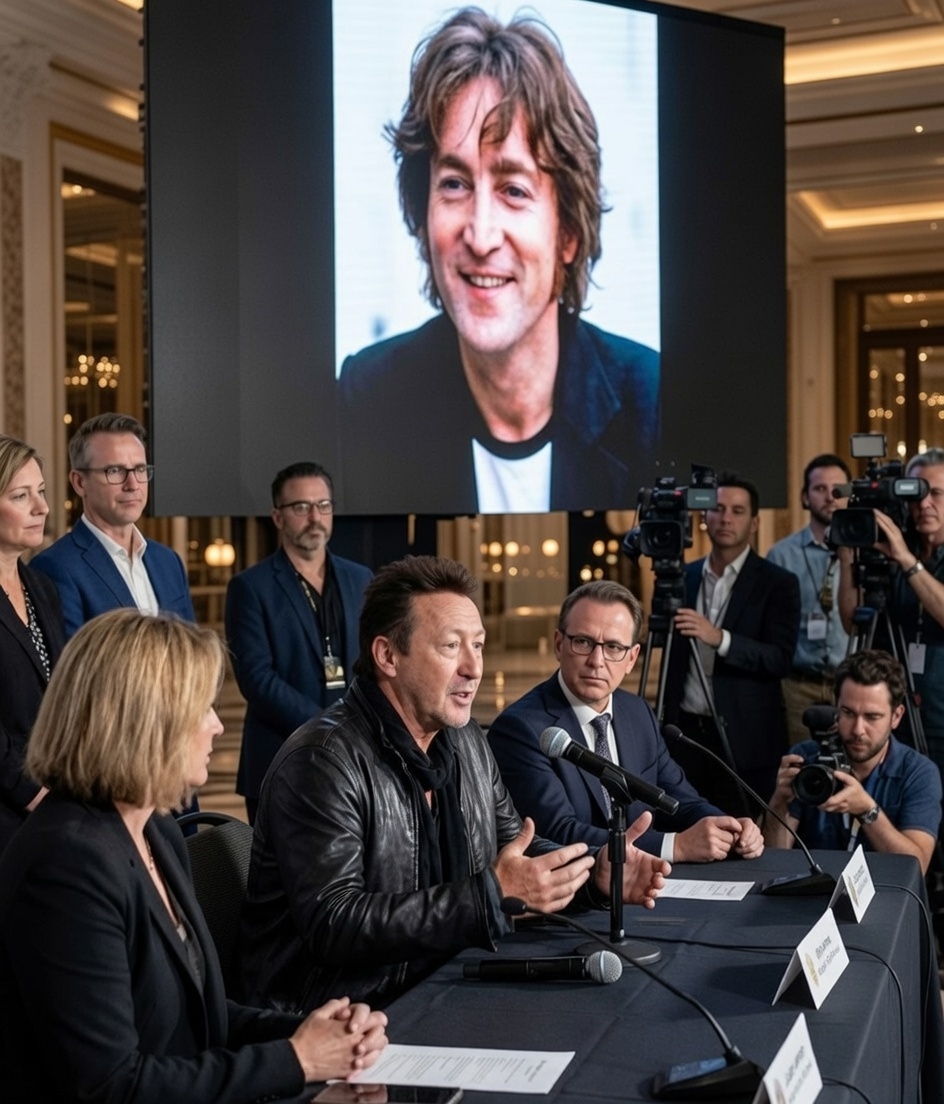
For decades, the story of John Lennon was a global parable. It was told in lyrics, interviews, and grainy film clips: the witty Mop Top, the psychedelic pioneer, the peace activist, the flawed but enlightened sage. It was a story with a clear, redemptive arc—from restless Beatle to househusband hero. But for one person, the narrative was not a parable to be studied, but a life to be lived in its long, complicated shadow. At 62, **Julian Lennon** has finally chosen to narrate that life from his side of the lens.
His revelations are not an indictment, but a quiet, profound correction of the record—a testament to a pain that time has softened but not erased.
### **The Unheard Verse: A Childhood in the Shadow of Genius**
Julian’s story begins not with fame, but with absence. He was the son of a young man hurtling toward superstardom, conceived just as Beatlemania ignited. In interviews, he describes a childhood punctuated not by paternal guidance, but by **glorious, intermittent visitation**. His father was a comet—brilliant, awe-inspiring, but always on a trajectory away from home.
The iconic Beatles song written for him, **“Hey Jude”** (originally “Hey Jules”), was penned by Paul McCartney to comfort the five-year-old Julian during his parents’ divorce. It stands as a bittersweet monument: a global lullaby born from his personal loneliness, a testament to his father’s absence by the very friend who tried to fill the void.
Julian speaks of a later, fleeting connection in the mid-70s, when a more settled John attempted to bridge the gap. But this fragile reconciliation was tragically severed by John’s murder in 1980, leaving Julian with a **ghost of a relationship and a lifetime of unresolved questions.**
### **The Legacy of an Unclaimed Inheritance**
For years, Julian Lennon navigated a uniquely painful public space. He bore a **striking physical and vocal resemblance** to his father, a constant, haunting reminder to the world and to himself. Every interview, every musical step, was met with comparison, an expectation to either emulate or repudiate a ghost.
His choice to pursue music was thus an act of immense courage. He had to find his own voice—literally and artistically—in an arena where everyone was listening for an echo. He succeeded with grace, crafting a respected career with hits like “Too Late for Goodbyes,” all while carrying the weight of a surname that is less a name and more a cultural epoch.
### **Why Speak Now? The Grace of a Late Truth**
The question hangs in the air: why break a decades-long public silence now? Julian’s answer is not one of bitterness, but of **clarity earned through time and healing**.
* **A Right to the Narrative:** At 62, he has outlived his father by over two decades. He is no longer the boy in the photograph, but a man with his own complete life. He is claiming the right to tell his part of the Lennon story, to assert that his experience is a valid and essential chapter.
* **A Softer Lens:** Age and distance have allowed the raw hurt to settle. His words are measured, reflective, and free of the sharp anger that might have colored them earlier. This lends his testimony a powerful credibility; it is an assessment, not an attack.
* **Completing the Portrait:** The world’s image of John Lennon is mythic. Julian’s account adds the vital, humanizing shadows—the complexities of fatherhood, the collateral cost of genius, the unfinished business that even the most enlightened leave behind. It doesn’t diminish John’s legacy; it grounds it in reality, making the man, and his journey toward being a better father to his second son, Sean, more comprehensible.
### **The Unfinished Echo**
Julian Lennon’s story is the **unresolved chord in The Beatles’ perfect harmony**. It is a reminder that legacies are not monoliths; they are fragmented, experienced differently by everyone they touch. For fans, John Lennon’s music preached love and imagined no possessions. For his first son, the legacy was more personal: it was the empty chair at the table, the unreturned phone call, the love that had to be imagined because it was so often absent.
By finally speaking, Julian Lennon has done more than share his truth. He has performed the ultimate act of claiming his inheritance. He has taken the echo of his father’s voice and, at long last, answered it with his own. In doing so, he hasn’t broken the legend of John Lennon. He has, with heartbreaking grace, finally completed the family portrait.