# **Songs That Refuse to Age: Five Queen Masterpieces That Redefined Music**
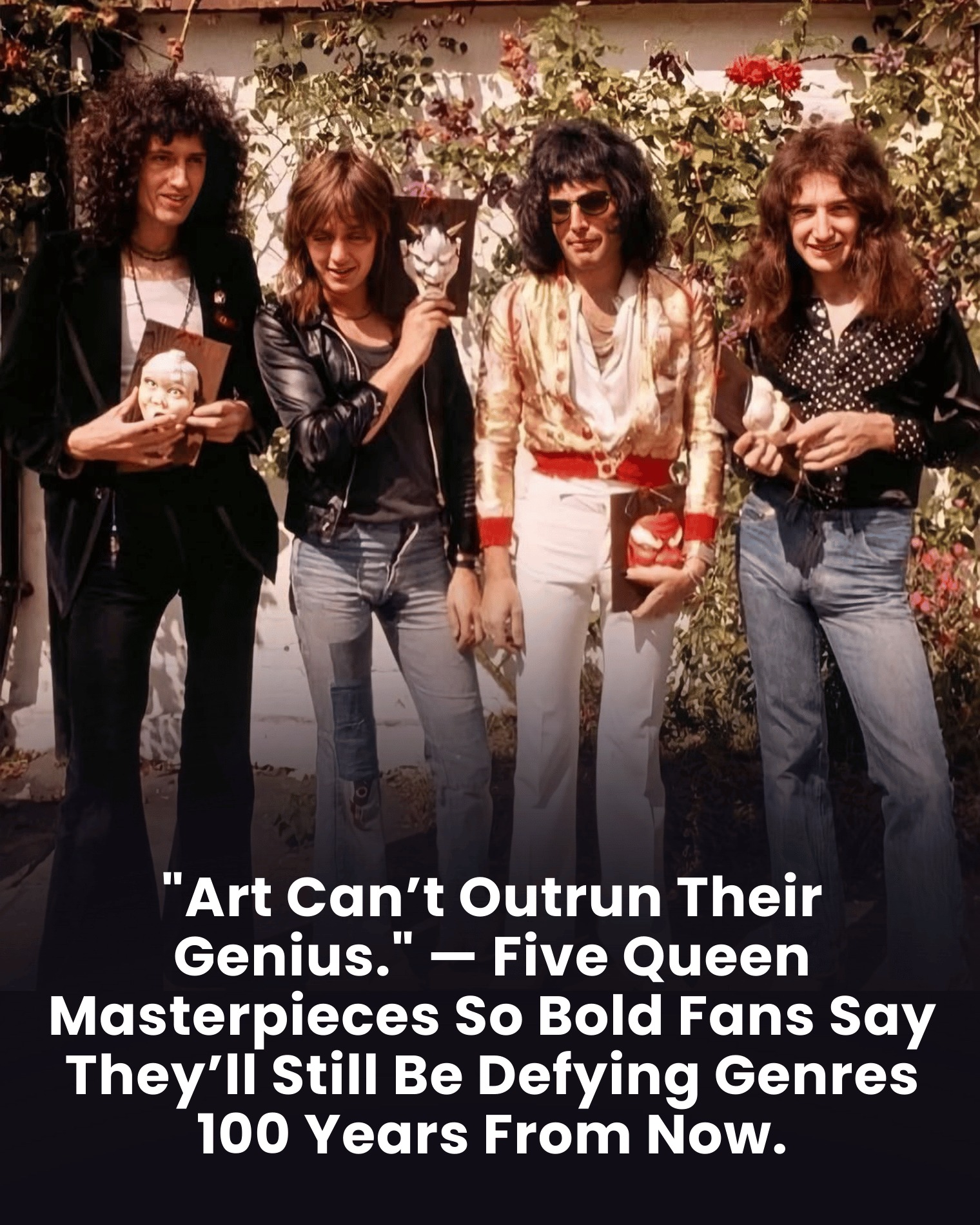
Queen’s legacy is built not on following trends, but on demolishing them. Their music remains timeless not because it sounds like any particular era, but because it is **an act of fearless creation** that transcends them. These five songs, each from a different creative phase, are permanent milestones because they didn’t just enter the culture—they changed the rules of what was possible in popular music.
### **The Five Fearless Masterpieces**
| Song & Year | Genre Shattered / Redefined | The Fearless Leap | Why It Remains Untouchable |
| :— | :— | :— | :— |
| **”Bohemian Rhapsody” (1975)** | The Rock Single / Album Radio | A 6-minute suite fusing ballad, opera, and hard rock with no traditional chorus, released as a single. | It is the ultimate testament to **artistic ambition over commercial formula**. Its emotional journey—from vulnerability to defiance to catharsis—is so complete it feels like a universe in a song. |
| **”We Will Rock You” / “We Are The Champions” (1977)** | The Stadium Anthem / Crowd Psychology | Stripping rock down to its most primal elements (stomp, clap, voice) to architect a universal, participatory experience. | It engineered a **permanent sonic ritual**. The beat is human, not technological, making it endlessly replicable and unifying in any language, in any generation. |
| **”Another One Bites the Dust” (1980)** | Rock’s Sonic Boundaries | Centering a hard-rock song on a cool, hypnotic funk bassline borrowed from disco, the genre rock purists derided. | It’s a masterclass in **sonic subversion**. It proved rock could be funky and dominant, crossing over to top the R&B and dance charts on its own irresistible, minimalist groove. |
| **”Under Pressure” (1981) (with David Bowie)** | The “Supergroup” Collaboration | A genuine, improvisational studio clash of two colossal creative forces, resulting in spontaneous magic, not a calculated duet. | It captures a **rare, authentic moment of genius**. The iconic bass line born from a jam, the traded vocals of two icons—it feels like witnessing the vulnerable, urgent act of creation itself. |
| **”I Want to Break Free” (1984)** | Music Video as Narrative & Social Commentary | Pairing a synth-driven, emotionally resonant rock song with a video featuring the band in drag, satirizing soap operas and gender norms. | It bravely **married sound and image to challenge convention**. The video’s bold, humorous statement gave the song’s theme of liberation a powerful, lasting cultural context far beyond the music alone. |
### **The Unifying “Queen Formula”: Why These Songs Are Immortal**
The genius of these tracks lies in a consistent, fearless philosophy:
* **Genre as a Tool, Not a Cage**: Queen never asked, “Is this rock?” They asked, “Does this serve the song?” They used opera, music hall, funk, and disco as colors on their palette to paint more vivid emotional pictures.
* **Emotional Truth at Grand Scale**: Whether it’s the operatic despair in “Bohemian Rhapsody” or the triumphant solidarity in “We Are The Champions,” the feelings are delivered with maximum conviction and theatricality. This grand-scale honesty is perpetually compelling.
* **Innovation in Service of Connection**: Every technical breakthrough—the multi-tracked vocal canon in “The Prophet’s Song,” the handmade guitar orchestras, the vocal harmonies—was never just for show. It was to create a deeper, more awe-inspiring connection with the listener.
These five songs are just the tip of the iceberg. The progressive rock epic **”The Prophet’s Song,”** the heavy metal precursor **”Stone Cold Crazy,”** or the vaudevillian **”Killer Queen”** all follow the same rule-breaking blueprint. Queen’s catalog is a masterclass in creative courage, proving that music crafted without fear, with emotional honesty and technical brilliance at its core, doesn’t just survive the passage of time—it **commands it**.