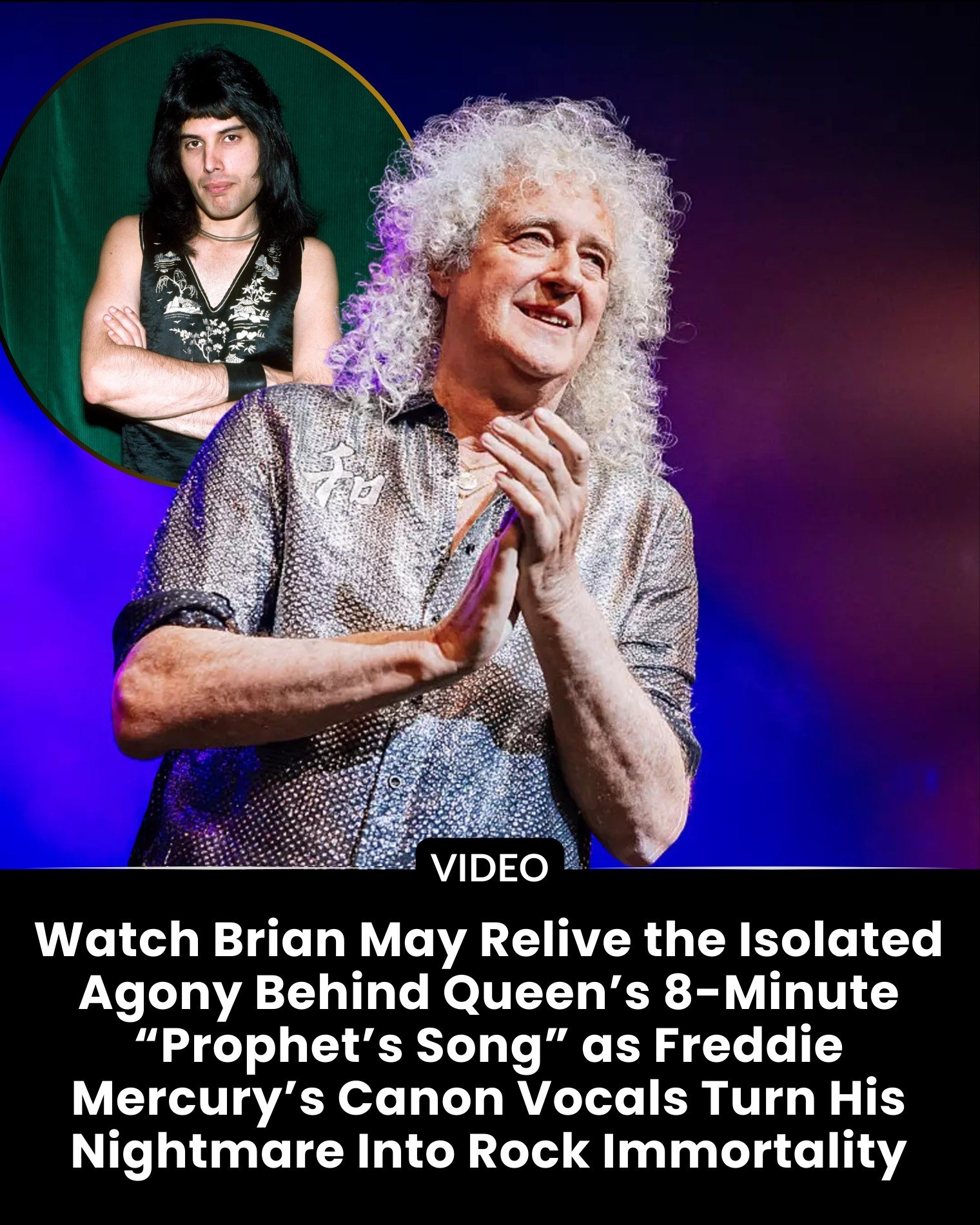
# **The Nightmare, The Canon, The Masterpiece: The Agony and Ecstasy of Queen’s “The Prophet’s Song”**
For many, “Bohemian Rhapsody” is Queen’s ultimate operatic rock epic. But for Brian May, the band’s most complex, personal, and agonizing creation is the 8-minute behemoth that precedes it on *A Night at the Opera*: **”The Prophet’s Song.”** It is a piece born not from jamming, but from a **vivid, apocalyptic nightmare**, and its journey from dream to disc is a story of isolated struggle and one bandmate’s breathtaking leap of faith.
**The Dream and The Agony**
The song began with May awakening from a terrifying, prophetic dream about a global flood. The music arrived not as a riff, but as a **fully-orchestrated soundscape** in his head—a complex, multi-part suite with shifting time signatures and a dense, harmonic structure. His agony was twofold: first, the burden of translating this intricate inner vision into reality; second, the near-impossible task of **explaining it to his bandmates.**
“In a way, it was a very isolated process,” May has recalled. “I had this thing complete in my brain… but getting it out and making other people understand it was agony.” He wasn’t bringing a sketch to the band; he was trying to conduct a symphony only he could hear.
**Freddie’s Leap of Faith: The Canon**
The song’s centerpiece—and the key to its immortality—was a daring, unorthodox idea from May: a lengthy, a cappella section where voices would weave in a complex **canon** (a round, like “Row, Row, Row Your Boat,” but on a rock god scale). It was a radical risk, a potential momentum-killer in the middle of a hard-rock epic.
This is where Freddie Mercury performed an act of **pure, creative trust.** Faced with May’s technical explanation, Mercury didn’t hesitate. He grasped the architectural vision and then, with his unparalleled vocal instrument and pre-digital precision, **built the cathedral.** Singing against himself on tape, he constructed the entire multi-layered canon vocal by vocal, his voice acting as a one-man choir. The result—”*Now I know!*” echoing, overlapping, and building into a tidal wave of sound—is not just a display of virtuosity; it’s the sound of a singer fully inhabiting a guitarist’s nightmare and **transforming it into dreamlike beauty.**
**The Legacy**
“The Prophet’s Song” stands as a unique monument in the Queen catalog. It is May’s most personal and ambitious composition, a multi-movement rock suite that is progressive, heavy, and hauntingly beautiful. But its existence is a testament to **collaborative genius.** May provided the terrifying, brilliant blueprint; Mercury provided the fearless, fluid execution that brought it to life.
To hear the isolated tracks is to understand the agony and the ecstasy: May’s meticulous, layered guitars creating a world of tension, and Mercury’s vocal canon soaring above it, turning a prophecy of doom into a masterpiece of hope and human connection. It is the sound of two distinct geniuses meeting at the outer limit of their abilities, and in doing so, forging a piece of rock immortality that truly has no equal.