# **The Song That Defied Gravity: The Unbearable Bravery of “The Show Must Go On”**
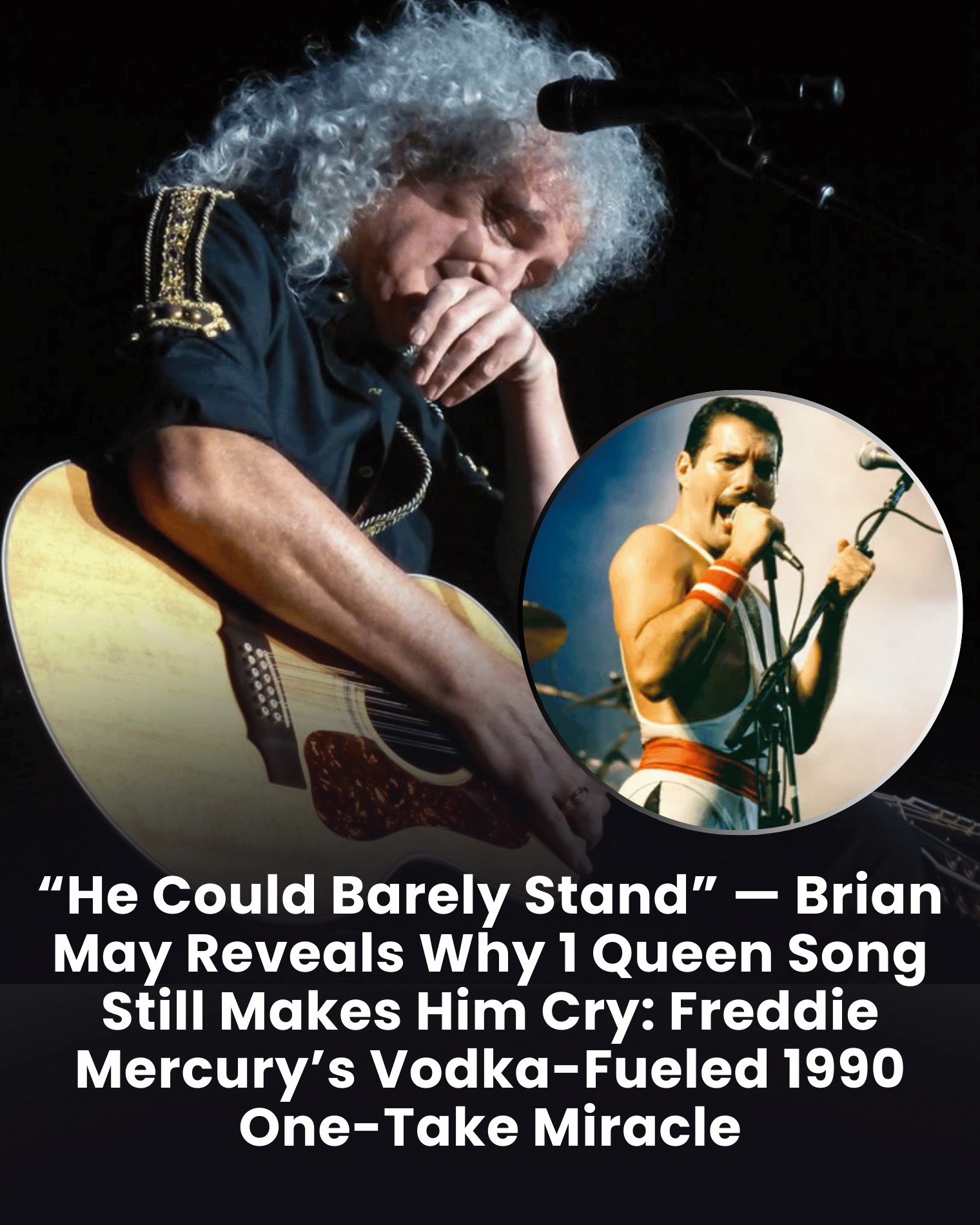
There are songs about heartbreak, and then there are songs that are the sound of a heart breaking in real time. For Brian May, **”The Show Must Go On”** is not just a Queen anthem; it is a sacred, devastating artifact—a recording so imbued with the circumstances of its creation that listening to it, even decades later, can feel like reopening a wound.
The facts are well-known but no less staggering for their repetition. By 1990, Freddie Mercury was dying. He was frail, in pain, and losing his eyesight. The band was gathering the fragments of what would become the *Innuendo* album, and the towering, orchestral skeleton of “The Show Must Go On” had been built by May. The lyric, however, was a direct, unflinching confrontation with mortality. It was a question, a dare, and a decree, all at once: *”The show must go on… inside my heart is breaking.”*
**The Moment of Impossible Bravery**
The story that brings May to tears is the moment of recording the final vocal. Facing Mercury in the studio, looking at a friend who could barely walk, May voiced a quiet, heart-wrenching concern. **”Fred, I don’t know if you can do this. Maybe we should save it for another day.”**
Freddie’s response was not in words, but in action. He reportedly fixed May with a look, downed a shot of vodka, and said, **”I’ll fucking do it, darling,”** or words to that effect. And then he proceeded to deliver one of the most powerful, layered, and emotionally cataclysmic vocal performances of his entire career—a performance that climbs to shattering high notes of almost unbearable intensity.
He didn’t just sing the song. He **lived its thesis.** With every fiber of his being failing, he used the last of his physical strength to create a monument to indomitable will. The raw, ragged vibrato on the final “*on*” isn’t a studio effect; it’s the sound of a body pushed beyond its limits by a spirit that refused to be defined by them.
**Why It’s Unbearable**
For Brian May, the song is a perfect, torturous paradox. It is the ultimate testament to Freddie’s courage, his professionalism, and his love for the band and the music. But embedded in every soaring harmony, every crashing chord, is the memory of the cost. It is the sound of a man building his own musical memorial, brick by agonizing brick, while his friends watched, helpless to do anything but play along.
To hear it is to witness that moment in the studio—not the myth, but the painful, beautiful, human reality of it. It is to hear the goodbye Freddie couldn’t say in words, but could only shout in song. The show did go on, long after he left the stage. But for the man who stood beside him that day, the song remains the most powerful and painful proof that some art isn’t just made—it is **paid for**, in courage, in pain, and in love that echoes forever in the silence that follows the final note.