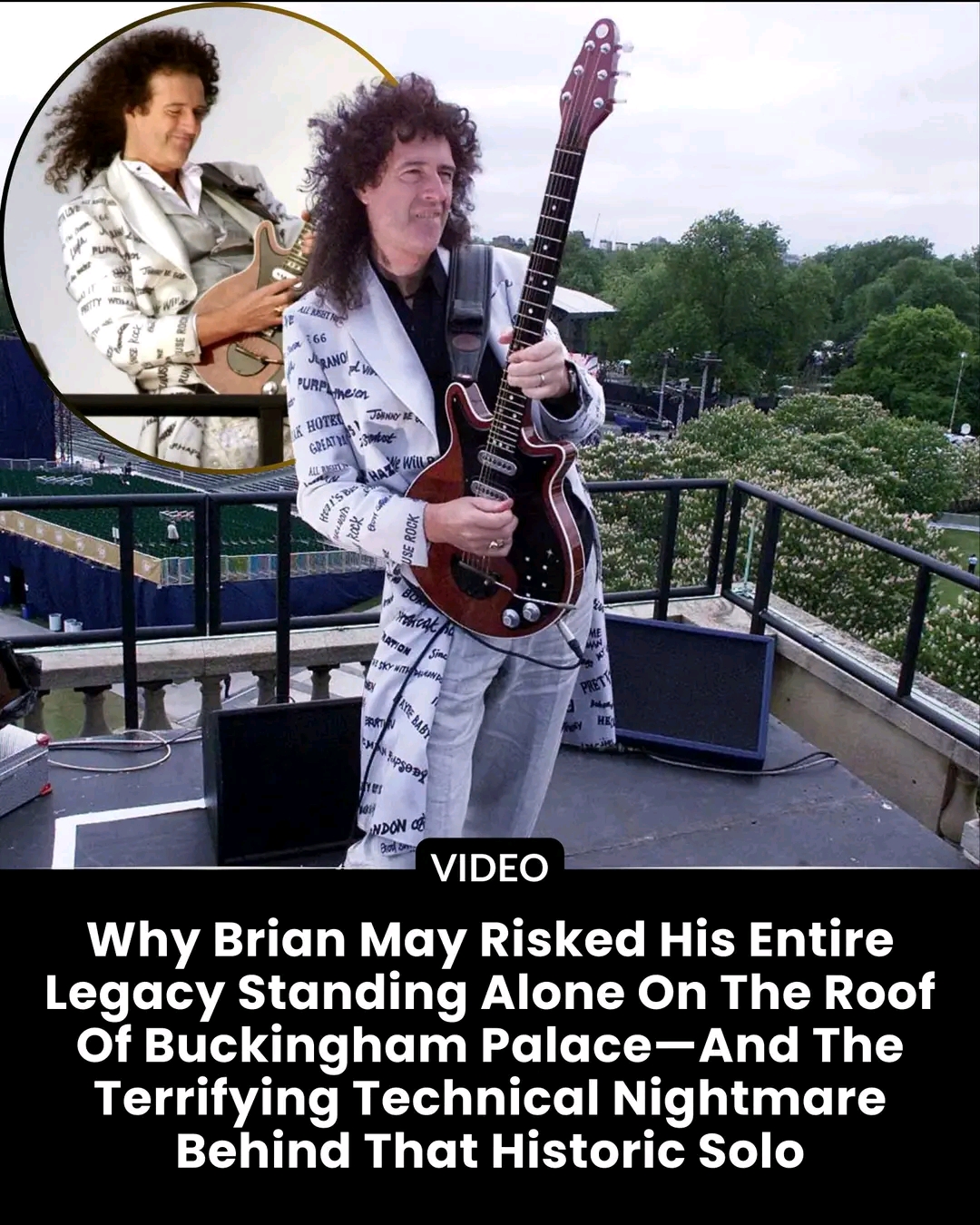
The Solo on the Edge of Silence: How Brian May Defied Chaos on the Palace Roof
It remains one of the most indelible images in modern British history: Brian May, a rock legend in a resplendent red coat, standing alone on the rain-slicked roof of Buckingham Palace. It was June 3, 2002, the opening of the Queen’s Golden Jubilee concert. His task was to perform a guitar rendition of the national anthem for a live audience of a million in The Mall and a billion watching worldwide. The pressure was galactic. But what the world didn’t see was the terrifying technical abyss that nearly swallowed the moment whole.
The Nightmare in the Monitors
As May took his position, a critical flaw emerged. The live audio feed from the orchestra and band, positioned far below on a stage, was being piped into his in-ear monitors with a disastrous delay. Hearing the music even a fraction of a second late would make synchronization impossible, turning his historic solo into a public, cacophonous train wreck. In that moment, perched above the most famous balcony in the world, he faced a catastrophic choice: play with the delayed track and certainly fail, or go rogue.
He chose intuition. With a silent prayer, he switched off his monitors entirely.
Playing into the Void
What followed was an act of supreme artistic courage. Stripped of any audible guide, May was plunged into near-total aural isolation. The roar of the distant crowd was a muffled wave. He could not hear the orchestra, the drums, or even the full resonance of his own iconic Red Special guitar clearly. He was playing into a void, forced to rely solely on three things:
1. Muscle Memory: The ingrained, physical memory of the piece in his hands.
2. Internal Metronome: His own impeccable, lifelong sense of timing.
3. Pure Faith: The trust that the musicians far below were following the same unseen tempo in his mind.
For over a minute, one of the world’s most precise musicians performed one of its most recognizable melodies completely by feel, betting his entire legacy on the accuracy of his own internal clock.
The Triumph of Instinct
The solo that soared over London was not just a performance; it was a high-wire act without a net. Each note was a leap of faith. When he struck the final, sustained chord and the orchestra swelled to meet him in perfect harmony, it wasn’t just technical success—it was a miracle of human intuition and professionalism.
Brian May didn’t just play “God Save the Queen” that day. He redefined nerve. He transformed a potential global embarrassment into a timeless, regal rock moment, proving that true mastery isn’t just about playing the right notes, but about having the courage to find them when every guidewire has been cut. The solo on the palace roof stands as a testament not to technology, but to the unshakeable instinct of a legend who heard the music where there was only silence.