# **The Beat That Built an Era: How a Deafened Drummer in Shea Stadium Rewrote the Rules of Live Music**
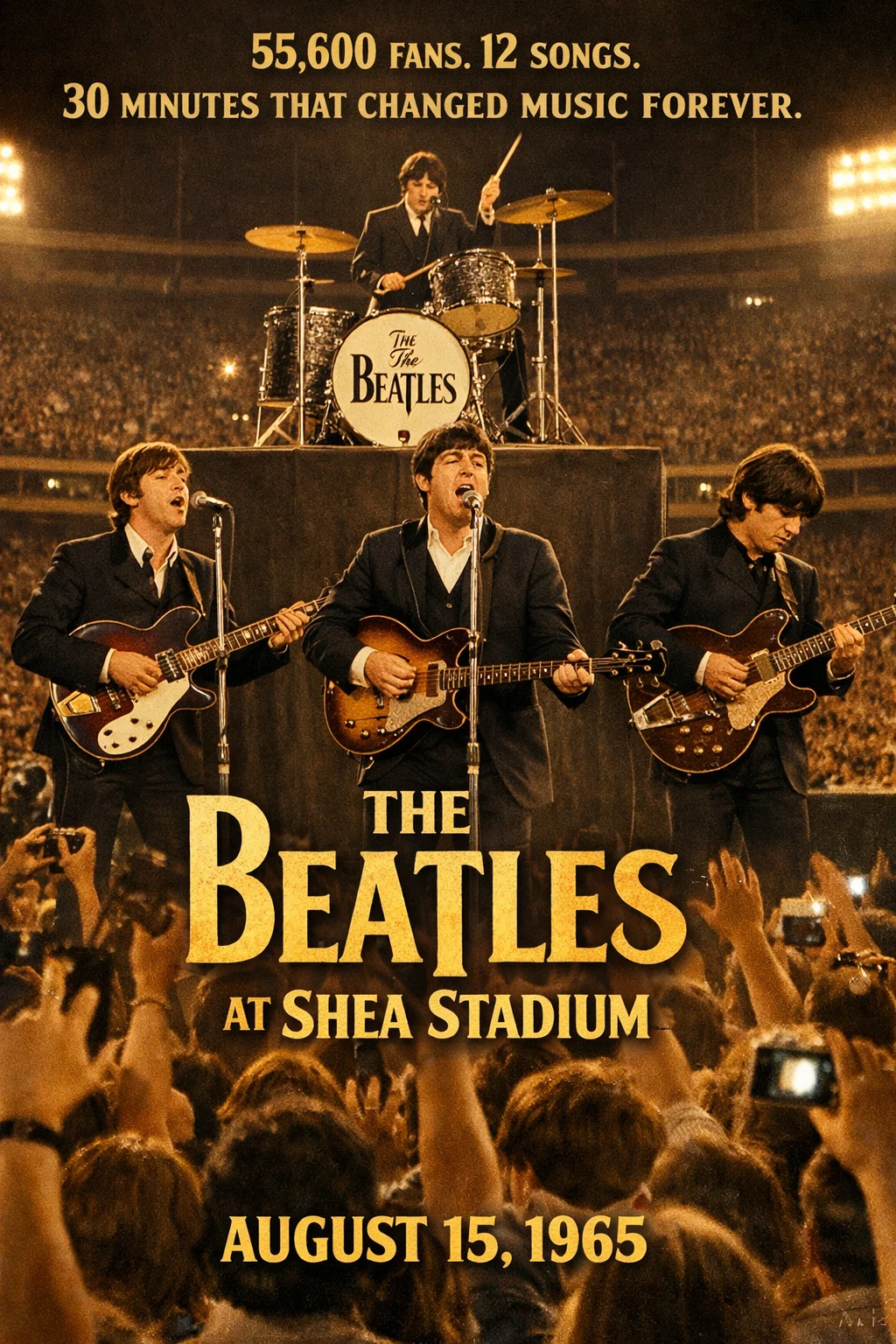
August 15, 1965. Shea Stadium. A low, persistent hum—the sound of 55,600 souls vibrating with anticipation—coalesced into a single, world-splitting scream. The Beatles took the field, not to a stage, but to an open pitcher’s mound. They were not just performers; they were **astronauts of sound**, launching into an atmospheric layer of hysteria no artist had ever breached.
**The Unheard Symphony**
Ringo Starr sat behind his Ludwig kit, a calm center in the visual hurricane. But his ears were met with a wall—a physical, disorienting barrier of pure noise. The Vox amplifiers, hopelessly overmatched, were rendered decorative. He couldn’t hear his snare. He couldn’t hear John’s rhythm guitar or Paul’s bass. The music existed only as a phantom vibration in the floorboards and the muscle memory in his hands.
He played not by sound, but by **faith**. Every backbeat, every fill on “Ticket to Ride,” every steady roll beneath “A Hard Day’s Night” was an act of profound trust—in his bandmates, in their shared internal clock, in the silent contract that the song existed even if it couldn’t be heard. He was the metronome for a symphony only the four of them, in some telepathic space, could perceive.
**The Calculus of Chaos**
The organizers were terrified. No one knew if a crowd that size could be controlled, if the flimsy stadium infrastructure could hold, or if the very concept of a musical performance could survive at such a scale. The Beatles didn’t just answer these questions; they **obliterated them**. They proved that the raw, gravitational pull of a cultural moment could overpower physics itself. The architecture of live entertainment was not just tested; it was rendered obsolete and rebuilt in that single, chaotic half-hour.
**The Legacy in the Noise**
Shea Stadium was not a concert. It was a **proof of concept**. It was the moment live music shed its acoustic skin and embraced its destiny as a massive, communal, sensory event. It created the blueprint for every stadium tour that followed—the sheer scale, the production arms race, the understanding that the spectacle is as crucial as the setlist.
Nearly six decades later, that imperfect, deafening, glorious 30 minutes remains the **big bang of modern pop spectacle**. It proved that history isn’t made with permission. It’s made by four friends from Liverpool, a relentless beat held steady in a storm, and the courageous, chaotic decision to play on, even when you can’t hear a single note. Ringo Starr, keeping time in the eye of the hurricane, didn’t just hold the beat for The Beatles that night. He set the tempo for the future of live music itself.