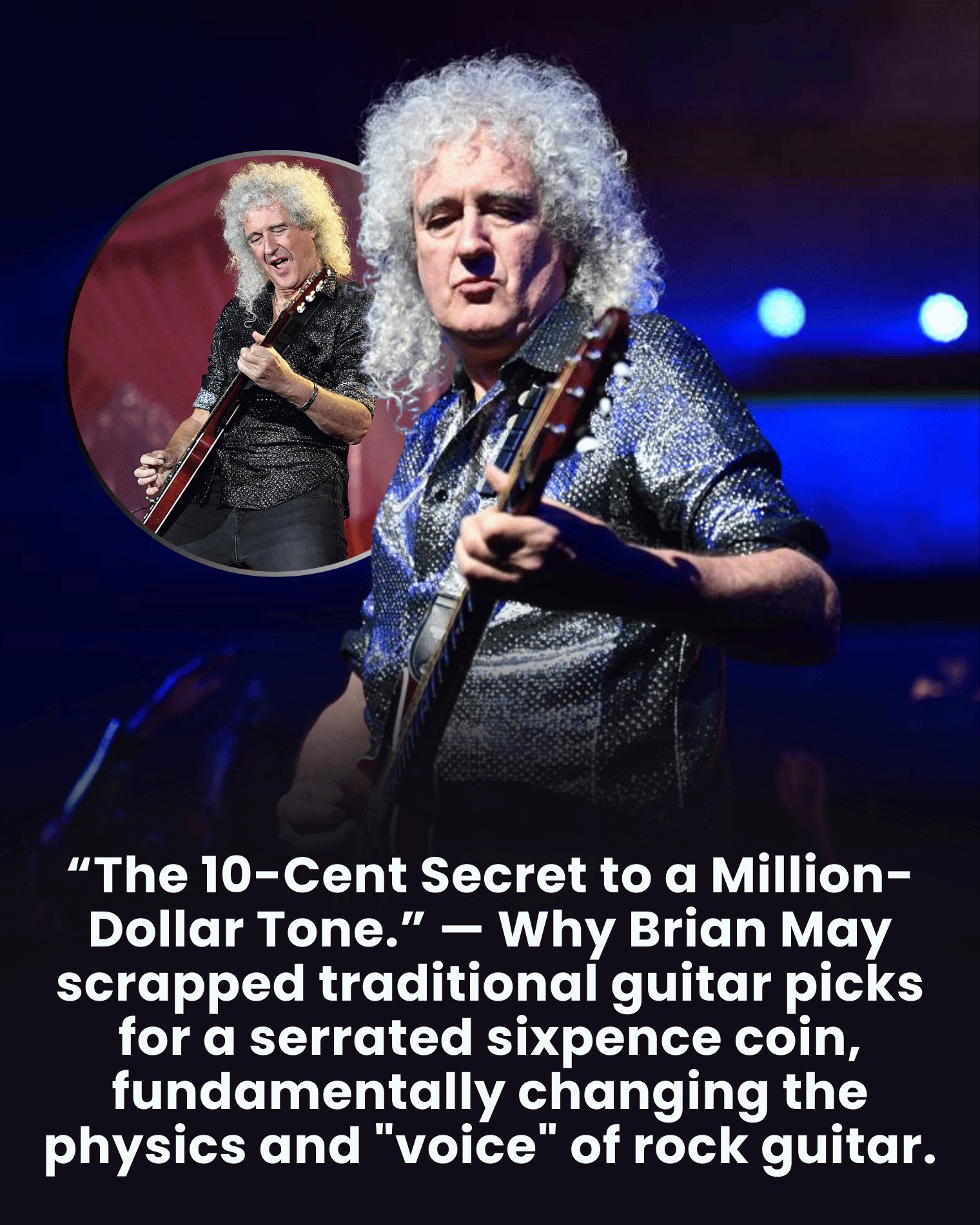
The Sixpence Symphony: How a Dime’s Worth of Coinage Forged Rock’s Most Operatic Guitar Tone
Brian May’s sound is one of the most iconic in rock history: a searing, vocal, multi-layered wall of harmony that weeps, sings, and roars. It’s often credited to his homemade “Red Special” guitar, his Vox amps, and his genius for orchestration. But the true secret weapon, the physical point of contact where his vision became vibration, cost almost nothing. It was a worn, serrated **sixpence coin**.
In the mid-1960s, a young Brian, building the Red Special with his father from fireplace wood and motorcycle parts, faced a problem. Standard plastic picks felt “flimsy” and “clicky” against his heavy-gauge strings. They lacked the attack and authority he heard in his head.
Reaching into his pocket, he pulled out a sixpence—a small, silver coin, then still in circulation in the UK. Its milled, serrated edges and rigid, unforgiving metal created an immediate revelation.
### **The Physics of a Million-Dollar Sound**
1. **Unforgiving Attack & Harmonic Sparkle:** A plastic pick flexes, absorbing energy. The solid coin does not. It transfers **all** of the player’s force directly into the string with a sharp, immediate *chunk*. This generates a richer burst of high-frequency harmonics—a “sparkle” or “bloom” at the note’s attack—that gives his sound its clarity and cut, even buried beneath layers of guitar and orchestra.
2. **Textural Serration:** The coin’s milled edge is subtly irregular. Unlike a smooth plastic edge, it introduces a minuscule, pleasing grit—a **natural distortion at the point of contact**. This adds body and a bowed-string-like complexity to clean passages, long before the signal ever hits an amp. It’s why even his clean tones feel alive and vocal.
3. **Dynamic Control & Emotional Weight:** Because the coin doesn’t flex, the player’s touch is hyper-translated. The slightest change in pressure or angle alters the tone dramatically. This gave May unparalleled dynamic expression. He could grind out a rhythm part with brutal weight, then roll the coin on its edge for a fluid, cello-like legato in a solo—all without touching a pedal. The emotion was in his fingers, transmitted faithfully by the coin.
### **The Soloist’s Scalpel**
Listen to the iconic solo in **“Bohemian Rhapsody.”** The way the notes sob and sigh, moving from a clean cry to a distorted wail, isn’t just a volume pedal. It’s the sixpence allowing him to dig in, ease up, and attack from different angles, making the guitar **emote** with the nuance of a human voice.
In **“We Will Rock You,”** that monstrous, percussive riff derives its fist-like punch directly from the coin’s rigid attack. A plastic pick would have made it thinner, less threatening.
### **A Legacy Struck in Metal**
The sixpence became so central to his identity that Queen’s crew had to scour antique shops as the coin was phased out, building a stockpile. For decades, every Queen album, every seismic anthem, was channeled through this sliver of discontinued currency.
Brian May’s sixpence is rock’s ultimate proof that tone is not bought—it’s **discovered**. It’s a testament to the power of a singular, idiosyncratic choice. He didn’t just find a pick; he found a translator for his musical soul. A 10-cent piece of history didn’t just shape a sound—it helped shape the emotional vocabulary of rock guitar itself, proving that the most revolutionary tools are often the simplest, and that true magic lies in the connection between a singular mind and an ordinary object used in an extraordinary way.