The Twenty Minutes That Shook the World: How Queen Rewrote History at Live Aid
The year was 1985. Queen, though still popular, were seen by the industry’s cutting edge as **a relic.** Their grandiose, theatrical rock was considered passé against the sleek synth-pop of the era. Critics had written them off as a fading, stadium-bound novelty. When the lineup for the historic Live Aid concert was announced, Queen’s inclusion was met not with excitement, but with sneering condescension. They were the “has-beens” on a bill with the future.
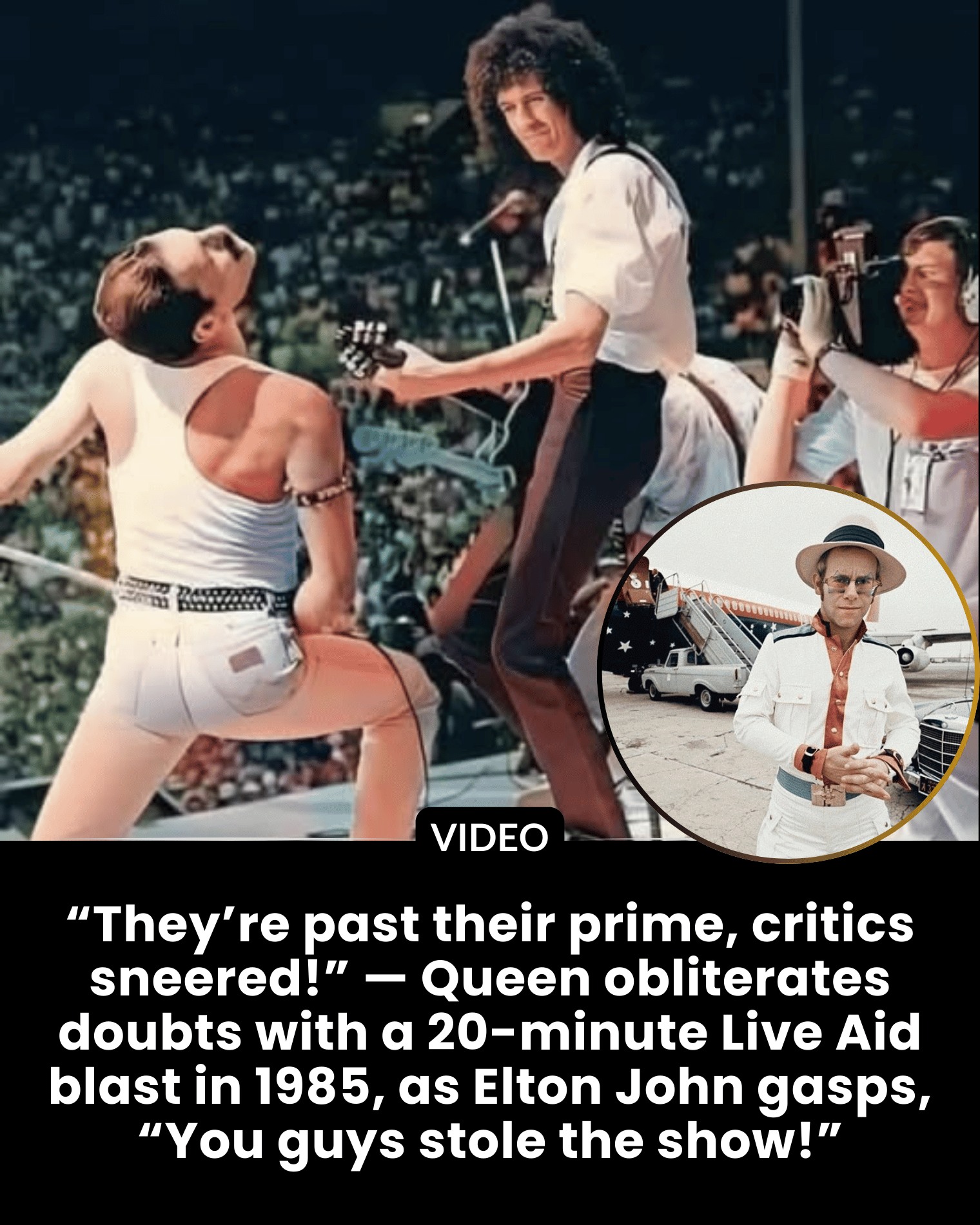
At Wembley Stadium, under the gaze of a live television audience estimated at **1.9 billion people**, Freddie Mercury, Brian May, Roger Taylor, and John Deacon had precisely twenty minutes to prove the world wrong.
What followed was not a performance. It was a **hostile takeover of history.**
From the first, iconic piano chords of **”Bohemian Rhapsody,”** it was clear the rules had changed. Freddie Mercury, in a simple white tank top and jeans, became a conductor of pure, undiluted energy. He didn’t just sing; he **commanded.** He held the vast stadium in the palm of his hand during the operatic section, then shattered the silence with a defiant fist pump into the hard rock finale. The crowd didn’t listen—they **surrendered.**
The set was a masterclass in ruthless efficiency: the call-and-response frenzy of **”Radio Ga Ga,”** where 72,000 people clapped in unison on cue; the fiery singalong of **”Hammer to Fall”**; the anthemic glory of **”We Are the Champions.”** There was no filler, no banter—just twenty concentrated minutes of explosive, undeniable showmanship. Freddie worked the stage like a man possessed, his voice a flawless instrument of power and emotion, making a global audience feel like an intimate club.
Backstage, the other performers knew they were witnessing something transcendent. **Elton John**, watching from the wings, turned to his manager and gasped, **”You guys stole the whole show!”** It was the stunned acknowledgment of a peer who had just seen the bar for live performance raised to a stratospheric new height.
In those twenty minutes, Queen didn’t just play a set. They **atomized doubt.** They transformed their perceived weaknesses—the theatricality, the grandiosity—into their ultimate strengths. They weren’t obsolete; they were **evolutionary.** They proved that songcraft, charisma, and raw, connective power could trump any fleeting trend.
Live Aid didn’t revive Queen’s career—it **etched it in granite.** It silenced the critics forever and re-established them not as a band of the past, but as one of the greatest live acts in the history of music. They walked onto that stage with everything to lose and walked off having stolen the day, rewritten their legacy, and given the world a masterclass in how to own a moment. **Twenty minutes was all it took to become immortal.