The Three-Week Obsession That Built “Bohemian Rhapsody” — and Nearly Broke Queen
LONDON, 1975 — The record label said it was too long. Radio programmers said it would never get played. Everyone said Queen was making a terrible mistake.
A six-minute epic? With an operatic middle section? No chorus? No repeated structure? It defied every rule of commercial music.
Freddie Mercury didn’t care.
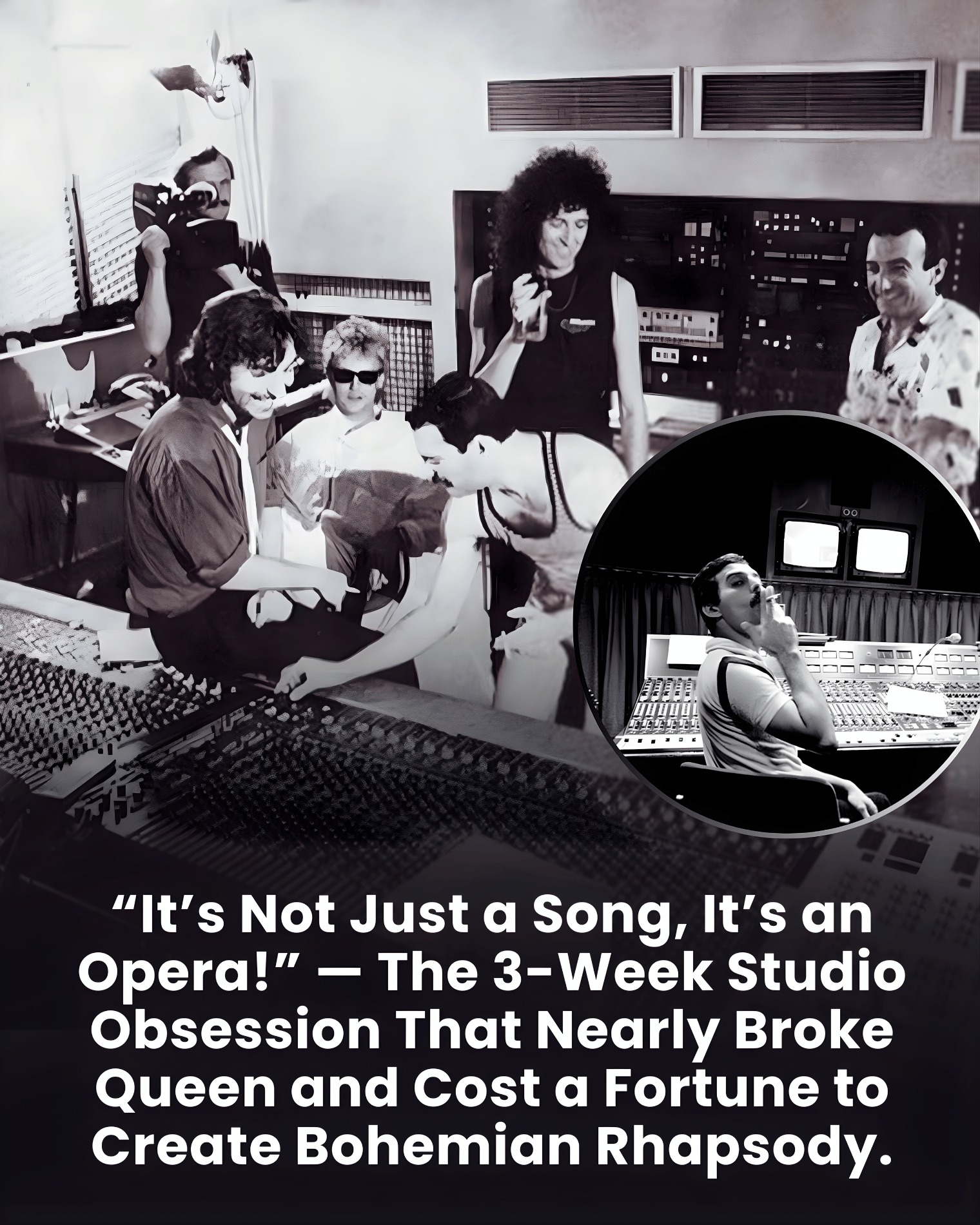
What followed inside Rockfield Studios in Wales was a three-week obsession that pushed Queen to their absolute limits. One hundred eighty vocal overdubs. Marathon sessions that stretched through nights and into mornings. Tape worn thin from constant playback. A mixing desk pushed beyond its designed capacity.
“Bohemian Rhapsody” wasn’t written. It was built — layer by layer, note by note, obsession by obsession.
The Process
Mercury arrived at the studio with the song mapped out in his head but not on paper. He would sing a section, the band would arrange around it, then he’d add another layer. The operatic section alone required so many vocal tracks that when engineers held the tape up to the light, they could see through it. The oxide was literally wearing away.
Brian May remembers the intensity. “We’d work until we couldn’t work anymore, then we’d start again. Freddie wouldn’t stop until it was exactly what he heard in his head.”
Roger Taylor’s voice was pushed to its upper limits, singing notes that would make most singers wince. May’s guitar solo was crafted with surgical precision. John Deacon’s bass held the chaos together.
One hundred eighty overdubs. For a song that, on paper, shouldn’t have worked.
The Risk
The label begged for a single. Three minutes. Something radio could play. Mercury refused. The song was the song. It would be released exactly as he heard it.
The gamble was enormous. Queen had invested everything in this track — time, money, creative energy. If it failed, there might not be a recovery.
But Mercury understood something the label didn’t. The song wasn’t just music. It was a statement. A declaration that Queen would not be constrained by rules written by others.
The Moment
When “Bohemian Rhapsody” finally premiered on radio, the switchboards lit up. Listeners called stations asking what they’d just heard. Demand grew. The song climbed charts. It stayed at No. 1 for nine weeks in the UK.
The six-minute epic that couldn’t survive radio had just conquered it.
Why It Worked
“Bohemian Rhapsody” succeeded because it refused to compromise. Every section served the whole. The opera wasn’t pretension — it was theater. The hard rock section wasn’t aggression — it was release. The quiet ending wasn’t anticlimax — it was resolution.
Mercury understood that audiences were smarter than the industry gave them credit for. They didn’t need three-minute formulas. They needed something that made them feel.
The Legacy
Nearly fifty years later, “Bohemian Rhapsody” remains one of the most streamed songs of the twentieth century. It has been analyzed, celebrated, and studied. It launched a film that grossed nearly a billion dollars. It is, by any measure, one of the most important recordings in rock history.
And it almost didn’t happen.
Because in 1975, a band with everything to lose decided to risk it all on a six-minute song that broke every rule.
The risk nearly broke them. Instead, it made them immortal.