### **A Crown Repolished: Brian May’s “Rebuild” of Queen II Aims to Correct a 50-Year-Old Regret**
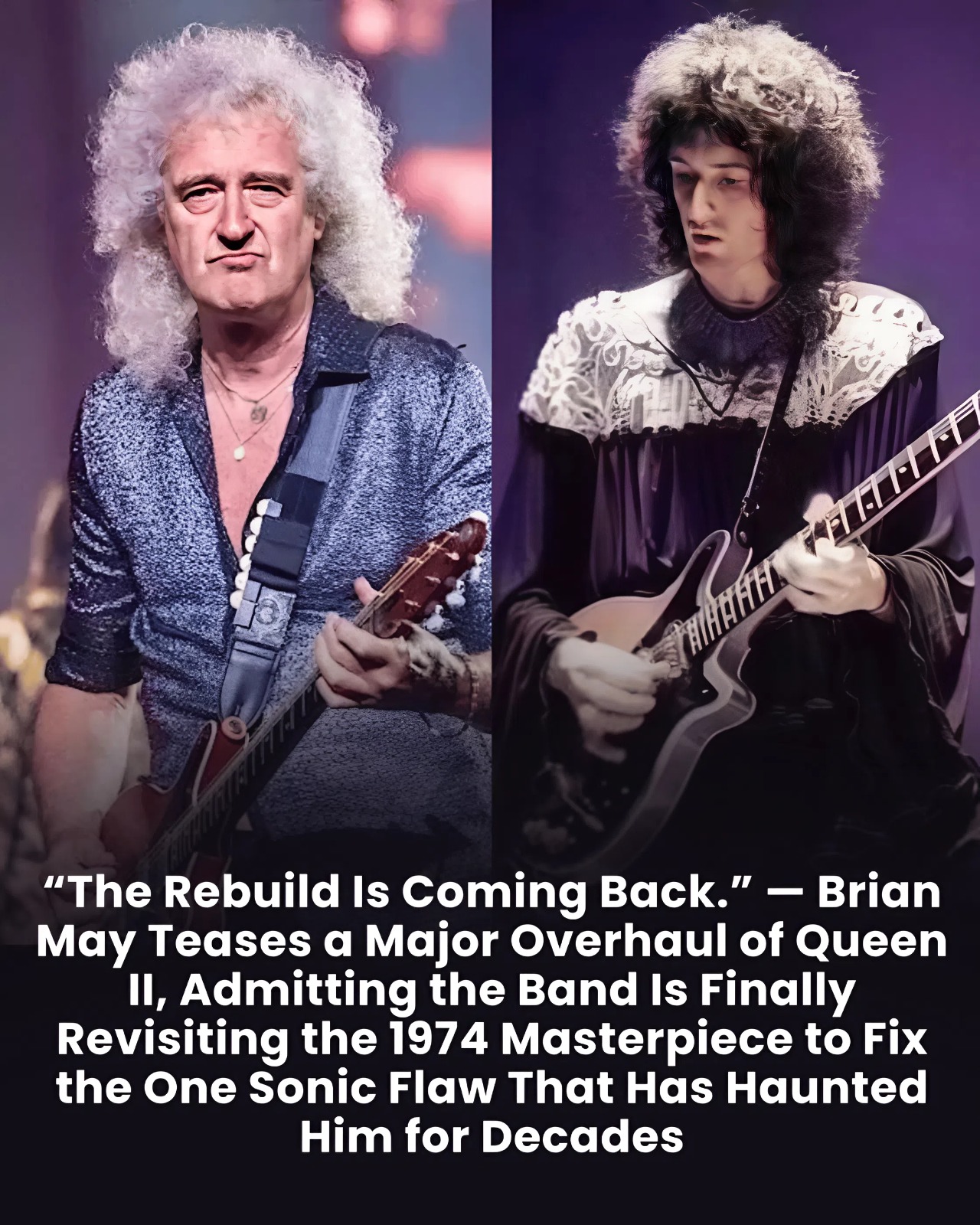
In the grand, cathedral-like edifice of Queen’s discography, *Queen II* (1974) stands as the dark, gothic cornerstone. A masterpiece of ambition and fantasy, it’s the album that birthed the “white queen/black queen” mythology, contained the explosive “Seven Seas of Rhye,” and laid the intricate harmonic groundwork for everything that followed. Yet, for guitarist and sonic architect Brian May, it has also been a source of quiet, enduring artistic regret. Now, he’s announced a mission to finally set it right.
Calling it **”The Rebuild,”** May has revealed that the band is undertaking a full-scale, top-to-bottom sonic overhaul of the *Queen II* album. This isn’t a simple remastering to make it louder. It’s a meticulous, track-by-track **”correction”** of the one flaw that has haunted him for decades: the album’s **thin, sometimes brittle sonic texture.**
“It was our first real foray into building our own universe in the studio,” May explained in a recent interview. “We had the vision—the layers, the harmonies, the drama. But we were pushing the technology of the time to its absolute limit, and frankly, beyond what it could faithfully capture. The tape machines were struggling, the mixing was rushed to meet a deadline… the end result never quite matched the thunder we heard in our heads. It’s always sounded a bit… pinched to me.”
The original sessions, helmed by producers Roy Thomas Baker and Robin Geoffrey Cable, were famously complex, with hundreds of overdubs on 16-track tape. In the rush to finish, the lush, layered sound—particularly the famed “wall of guitars” and Freddie Mercury’s stacked vocal harmonies—was often compressed into a narrow, tinny frequency range, losing its intended weight and warmth.
The “Rebuild” project, utilizing modern audio restoration and mixing technology, aims to **unlock that trapped thunder.** May and longtime Queen studio collaborator Kris Fredriksson are reportedly working from the original multi-track session tapes, painstakingly isolating and rebalancing elements. The goal is to reveal the album’s intended depth, giving Roger Taylor’s drums their full cannon-like power, allowing John Deacon’s basslines to rumble with foundation-shaking force, and letting May’s harmonized guitars soar with the cathedral-sized resonance he originally envisioned.
Rumors also swirl of **”lost material”**—alternate takes, extended sections, or even fully arranged songs from the sessions that were abandoned due to time constraints—being considered for inclusion in a super-deluxe edition.
For fans, this is more than a nostalgia trip. It’s an unprecedented opportunity to hear a foundational text of progressive rock as its creators always wished it could be heard. It’s the closest thing to a time machine, offering a *Queen II* with the sonic muscle of *A Night at the Opera* and the clarity of the modern era.
By fixing the flaw that has echoed in his mind for half a century, Brian May isn’t just revisiting history. He’s **reclaiming it**, ensuring that the dark, glorious fantasy of *Queen II* finally sounds as massive, majestic, and immortal as the vision that created it.