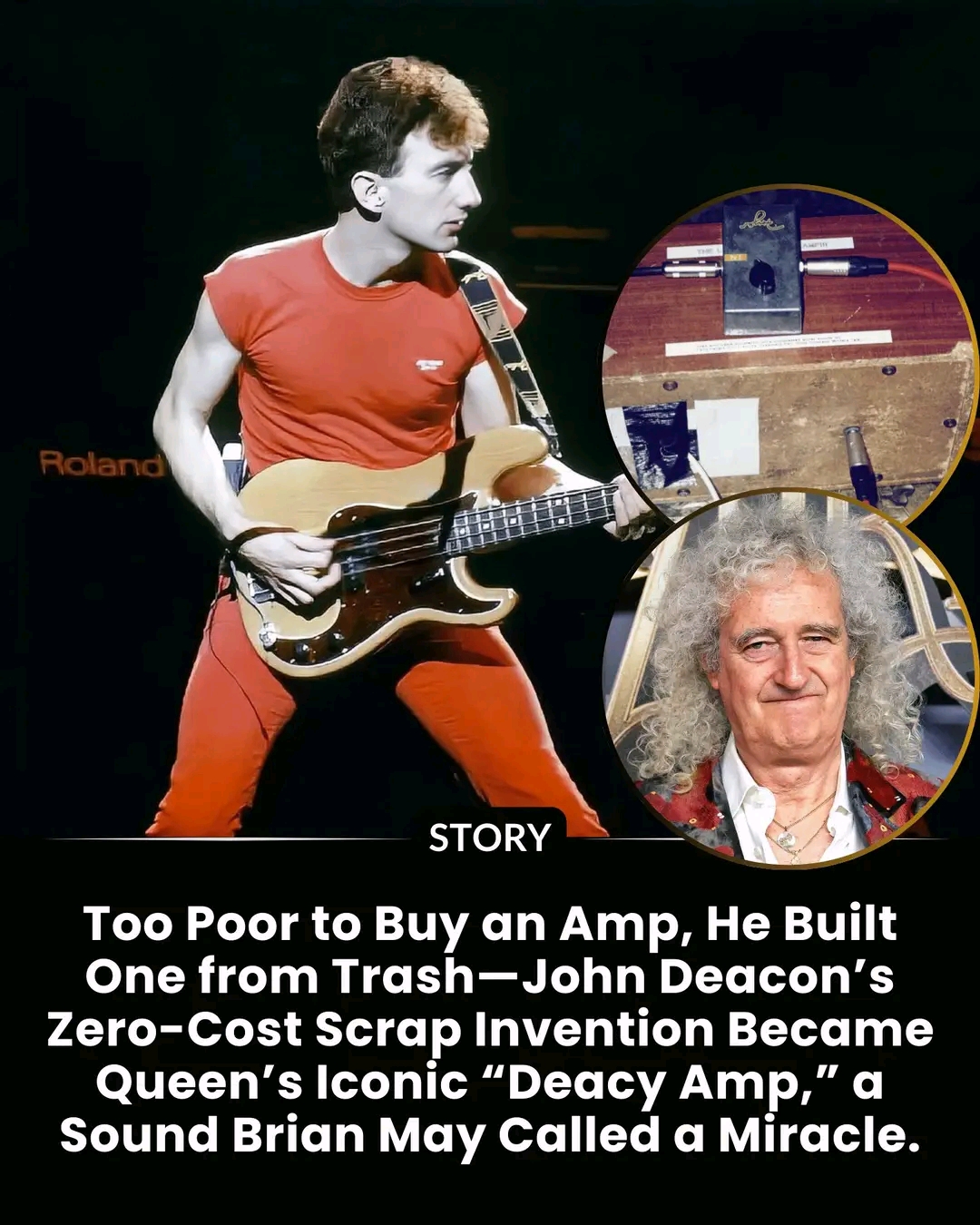
The Sound from the Skip: How John Deacon’s Trash-Built Amp Forged Queen’s Signature Sound
In the origin story of Queen, a band defined by colossal ambition and virtuosic excess, the tale of the Deacy Amp stands apart. It is a story not of wealth or cutting-edge technology, but of quiet genius, absolute necessity, and the alchemy that happens when a brilliant mind meets a pile of junk.
The year was 1972. Queen was a fledgling band, playing pubs and colleges, living on a fraying shoestring. Bassist John Deacon, the band’s youngest and most reserved member, was also its resident electronics whiz—a talent honed during his Electrical Engineering studies at Chelsea College. He had an idea. He’d heard the distinctive, violin-like tones Brian May was coaxing from his homemade Red Special guitar, but they lacked the rich, layered, orchestral texture he envisioned in his head. A proper amplifier to achieve that sound was far beyond their means.
So Deacon looked not to a music shop, but to a London rubbish bin.
Salvaging a discarded circuit board from a broken audio unit, he took it back to his flat. With meticulous patience, he de-soldered and re-soldered components, pairing the scavenged board with a small, second-hand speaker he’d found. He housed the entire creation in a battered, homemade wooden box. The total cost: zero pounds. The result was a tiny, unassuming, and almost absurdly fragile-looking device. They dubbed it the “Deacy Amp.”
When Deacon first presented it to Brian May, the reaction was skeptical curiosity. But the moment May plugged in his Red Special, the room changed. The Deacy Amp didn’t just amplify; it transformed. It produced a warm, clarion-clear, cello-like tone that could be layered without becoming muddy. It was the missing piece in May’s quest for a “guitar orchestra.”
“It was a miracle,” May would later say, reverence in his voice. “This little box John built from literal rubbish gave us a sound no one else on earth had.”
The Deacy Amp became the secret weapon on Queen’s most iconic recordings. Its sound is the backbone of the lush, multi-tracked guitar harmonies in “Bohemian Rhapsody.” It provides the chiming, bell-like textures in “Good Old-Fashioned Lover Boy” and the soaring, vocal-like leads in “It’s Late.” It was not a loud amp—it was a recording amp, a delicate paintbrush for the studio canvas.
Its magic was in its imperfection and limitation. The unique way it clipped and compressed the signal, the specific mid-range frequency it emphasized—these were happy accidents of its scavenged components, accidents that Deacon’s keen ear recognized as sonic gold.
For decades, the exact circuitry of the Deacy Amp remained a mystery, a closely guarded secret. Even experts who opened it could not reverse-engineer its genius; it was too singular, too much a product of one man’s intuitive understanding of sound and electricity.
John Deacon, the quiet Beatle of Queen, never sought the spotlight. But in that act of creation—born from poverty, built from trash, and gifted to a friend—he engineered one of the most distinctive and enduring sounds in rock history. He proved that the future of music isn’t always found in the newest, most expensive gear. Sometimes, it’s waiting in the skip, needing only the right mind, the right hands, and a soldering iron to change everything. The Deacy Amp wasn’t just an amplifier; it was the humble, humming heart of Queen’s majestic wall of sound.