46 Years Ago, the World Lost John Lennon. His Presence Has Never Fully Left.
It has been 46 years since the world lost John Lennon. Not gradually. Not with warning. Just a sudden moment that changed everything — and then a silence that never really settled.
That night in 1980, outside The Dakota in New York City, something ended. But what followed wasn’t only grief. It was stillness. The kind that spreads slowly, as people begin to understand that a familiar voice will not be heard in the same way again.
Forty-six years is a long time. Long enough for entire generations to grow up knowing him only through records, stories, and memories passed down. Long enough for his presence to shift from something lived in real time to something discovered.
And yet — he never fully left.
His songs still appear in quiet rooms, in late-night thoughts, in moments where people search for something honest to hold onto. “Imagine” still finds its way into vigils and gatherings, its vision of peace as distant and necessary as ever. “Working Class Hero” still speaks to anyone who has ever felt the weight of a system designed to keep them small. “Beautiful Boy” still makes parents cry, the love in it so pure that its source — a man often portrayed as cynical — becomes impossible to dismiss.
His words still return in conversations about peace, truth, and what it means to be human in a complicated world. With The Beatles, and through his solo work, John didn’t just create music — he created reflections of himself that continue to speak across time. The wit. The anger. The tenderness. The confusion. The search. All of it, still present.
What makes his absence feel so present is not only what he finished, but what he didn’t get to complete. The sense that there was still more he might have said. More he might have become. That unfinished feeling lingers quietly in the background of history — a song left unrecorded, a thought left unexpressed, a reconciliation left unspoken.
But time also changes the way we remember. It softens the shock. It allows space for something more gentle to remain — the sound of his voice, the honesty in his words, the way he never tried to hide his contradictions, and the way he kept searching, even when answers weren’t clear.
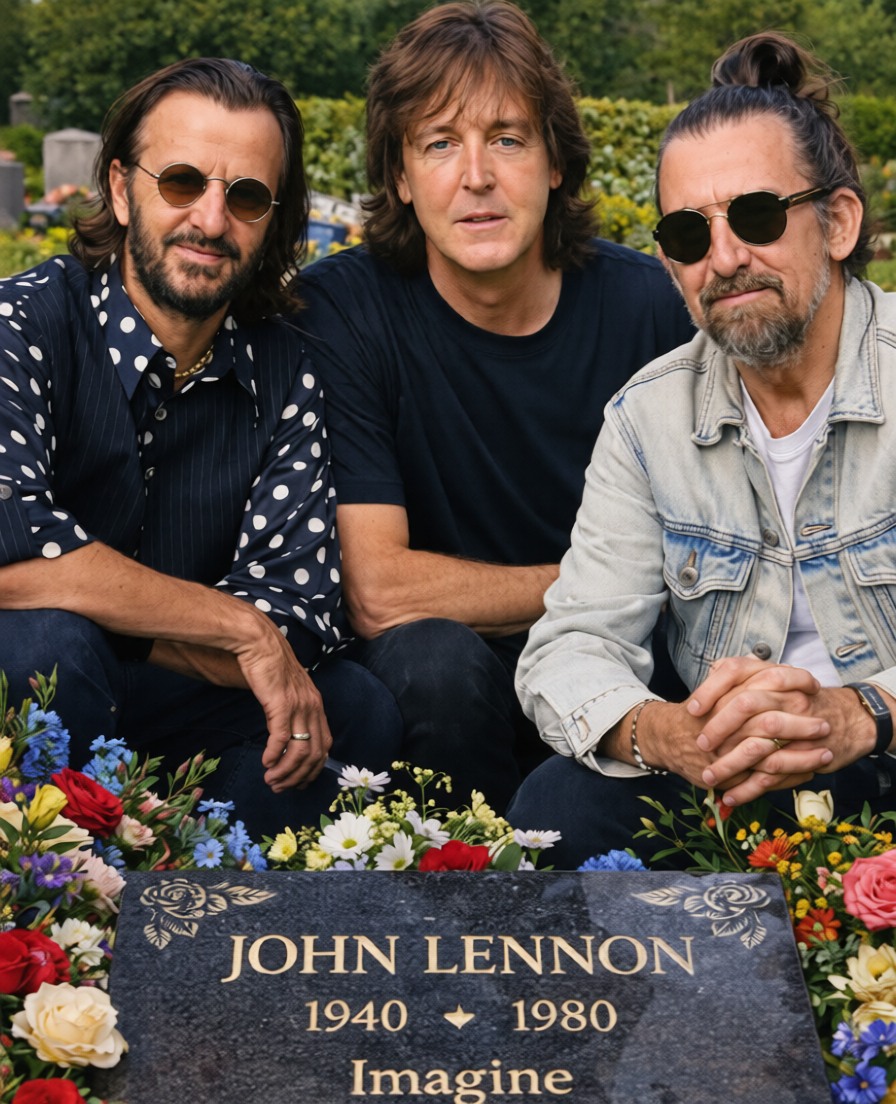
Today, the world is different. The Dakota remains. Central Park, where Strawberry Fields was created as a quiet place of remembrance, still draws visitors from everywhere. They leave flowers. They write his name in chalk. They sit on the bench and listen to someone play his songs on a guitar.
And every so often, his presence still slips through. Not loudly. Not constantly. Just enough to remind us — he was here. He loved. He struggled. He imagined. And somewhere, in the space between what he wrote and what we still need, he remains.
Not as a ghost. As a voice. Still speaking. Still singing. Still here.