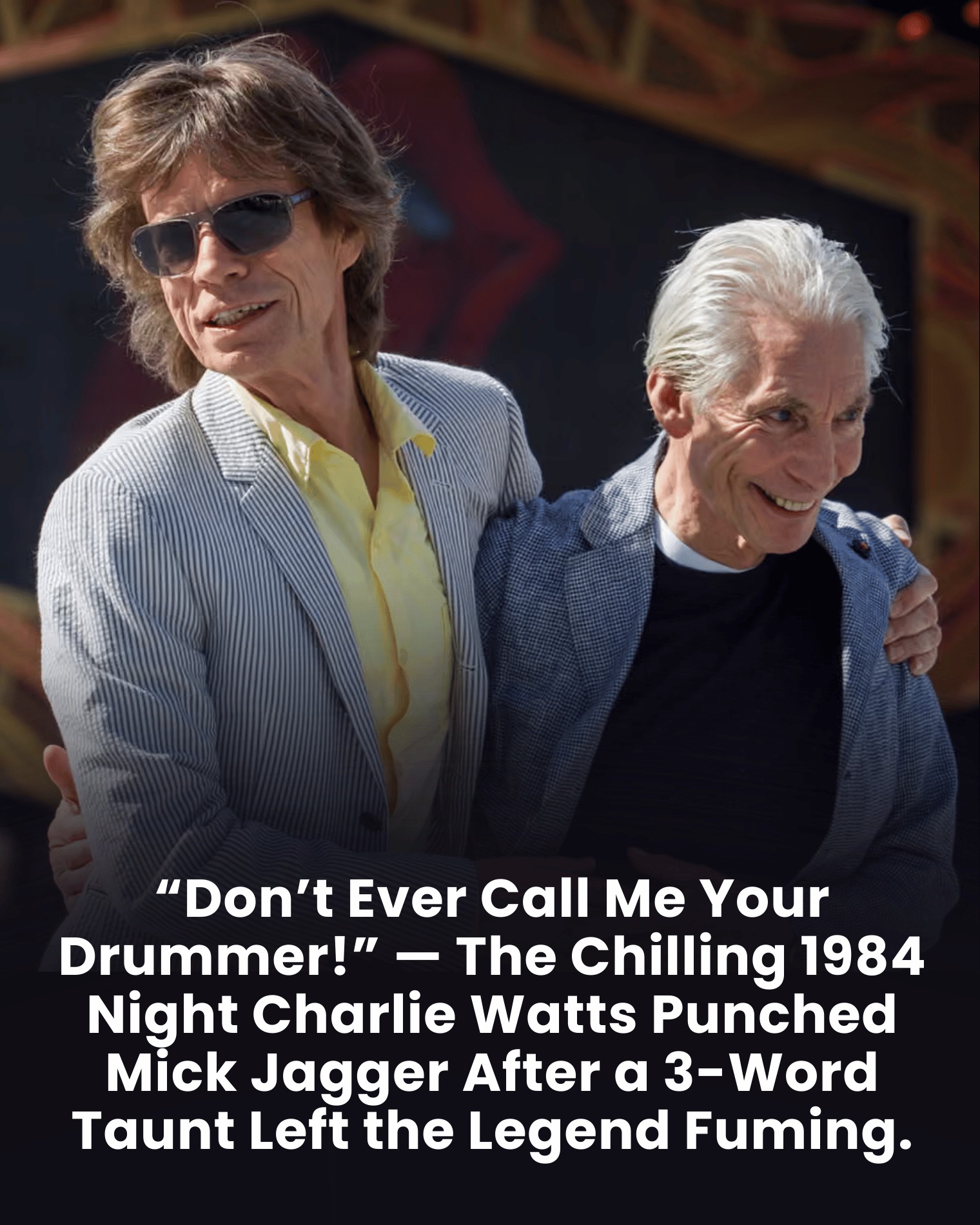
The Night Charlie Watts Punched Mick Jagger: The 1984 Amsterdam Incident That Shook The Rolling Stones
AMSTERDAM, 1984 — The Rolling Stones were never known for peace and quiet. But one late-night call in Amsterdam pushed tensions inside the band to a breaking point — and the fallout still echoes decades later.
The incident began, as many do, with alcohol. Mick Jagger, returning to his hotel after a night out, was in a state. He needed his drummer. And he needed him now.
According to multiple accounts, Jagger picked up the phone and called Charlie Watts’ room.
“Where’s my drummer?” he reportedly slurred.
The line went dead.
The Response
Charlie Watts was many things. A jazz devotee. A fashion icon. The quiet anchor of the world’s greatest rock and roll band. What he was not was someone who took orders.
Minutes later, a knock came at Jagger’s door.
Jagger opened it to find Watts standing in the hallway — immaculately dressed in a tailored Savile Row suit, perfectly composed, and utterly furious.
Without a word, Watts grabbed Jagger by the lapels and delivered a single, devastating punch.
The Punch
Accounts differ on exactly where the punch landed, but all agree on its effect. Jagger stumbled backward, stunned not just by the impact but by the source. Watts — the quiet one, the gentleman, the man who rarely raised his voice — had just knocked the frontman across the room.
Jagger reportedly retreated to a nearby café to compose himself. Watts returned to his room as if nothing had happened.
The Aftermath
The next morning, the band gathered, uncertain what the fallout would be. Watts arrived first, dressed impeccably as always. Jagger walked in moments later, visibly hungover and bearing the evidence of the previous night’s encounter.
Watts looked at him calmly and said: “Don’t ever call me your drummer again. You’re my fucking singer.”
The room went silent. Then, slowly, laughter broke the tension. The incident passed — but not without leaving its mark.
What It Revealed
The moment crystallized something essential about The Rolling Stones. Jagger was the frontman, the showman, the public face. But Watts was the foundation. Without him, the band’s sound — that unmistakable swing, that jazz-inflected groove — simply didn’t exist.
The punch wasn’t just about a late-night phone call. It was about respect. About acknowledging that every member of the band carried equal weight, regardless of whose name was in lights.
Decades Later
Watts died in 2021 at age 80. Jagger spoke at his funeral, delivering a eulogy that acknowledged both the punch and the profound bond beneath it.
“We pushed each other,” Jagger said. “Sometimes literally. But Charlie was irreplaceable. He still is.”
The Amsterdam incident has become legend — a story fans tell to illustrate the dynamic that made The Stones work. Four distinct personalities, each willing to hold their ground. Even if it meant a fistfight in a hotel hallway.
Charlie Watts never raised his voice. But when he raised his fist, even Mick Jagger listened.