### **The Unsingable Anthem: How One Shot of Vodka and Pure Defiance Created Freddie Mercury’s Final Masterpiece**
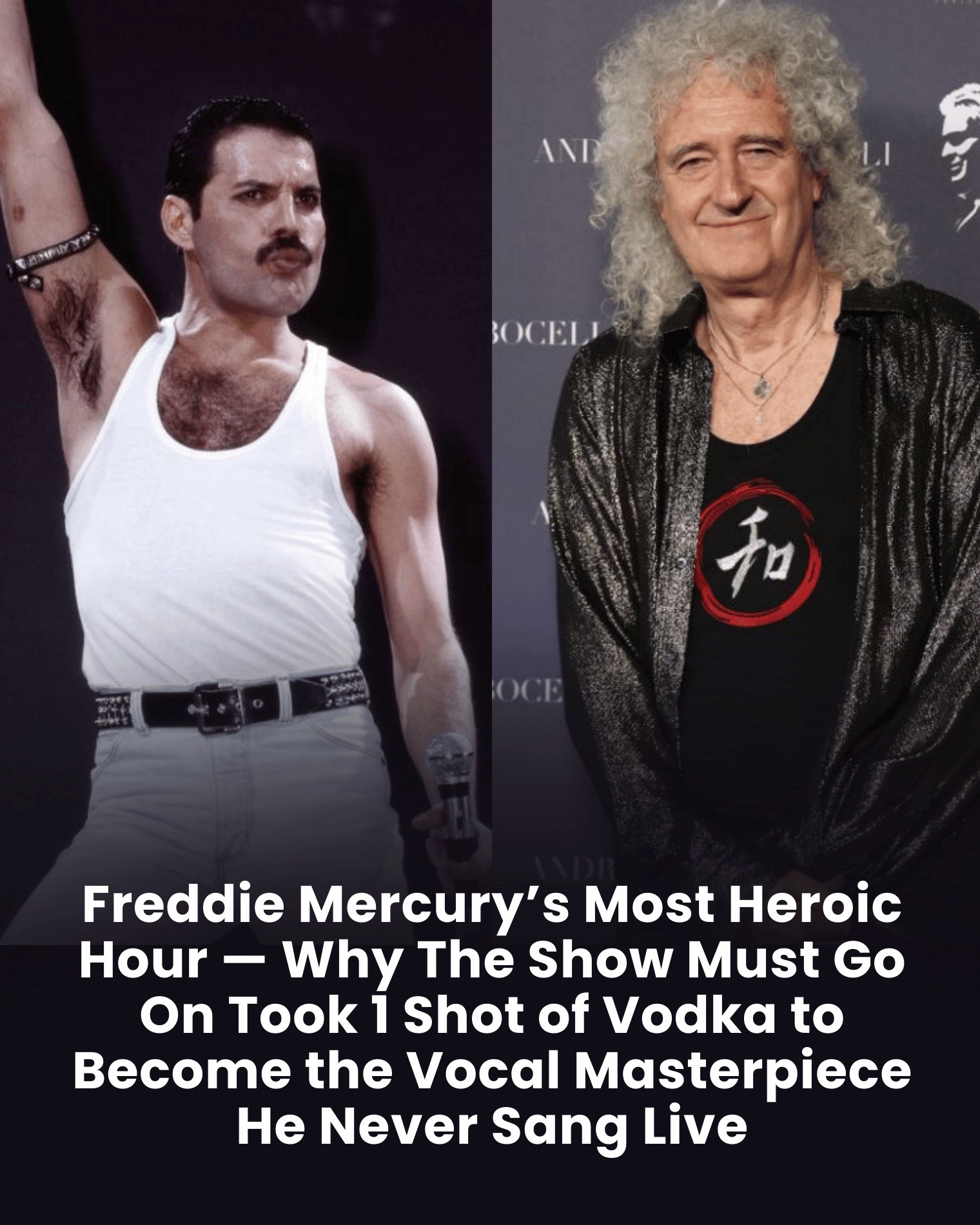
By the autumn of 1991, the unspoken truth in Queen’s camp was a deafening roar. Freddie Mercury was dying. His body was ravaged by AIDS, his energy a precious, finite resource. Yet, in the heart of this gathering darkness, the band was assembling their final album, *Innuendo*, and a new song by Brian May loomed as both a challenge and a testament. Its title was a mantra, a promise, a gauntlet thrown at fate itself: **”The Show Must Go On.”**
The track was a monumental piece of music—a slow-building tidal wave of orchestral rock, rising from a somber piano lament to a thunderous, operatic crescendo. The vocal line was its own Everest: an emotional marathon demanding raw power, operatic sustain, and a superhuman leap into a anguished, sustained high note on the line **”I’ll top the bill, I’ll overkill…”** It was, by design, almost unsingable.
In the studio, the atmosphere was thick with unspoken fear. Could he do it? *Should* he even try? To ask a man fighting for every breath to scale this peak felt almost cruel. But Freddie, ever the professional, ever the performer, read the room. He saw the doubt, the protectiveness, the heartbreak in his bandmates’ eyes.
His response was pure, distilled Mercury defiance.
According to band lore, he looked at the daunting sheet music, then at his friends. **”I’ll fucking do it, darling,”** he reportedly said, his eyes blazing with a familiar fire. Then, he called for a shot of vodka. Not for courage, perhaps, but for **focus**—a tool to steady the tremor, to cut through the pain, to summon the last reserves of the titanic instrument that was his voice.
With the tape rolling, he stood at the microphone. The opening chords swelled. And then, in what is believed to be a single, continuous take, Freddie Mercury delivered a performance that defies belief.
He didn’t just sing the song; he **lived its manifesto.** His voice, thinner in places yet burning with an almost supernal intensity, navigated the treacherous melody. When he launched into the final, seismic chorus—*”The show must go on!”*—it was not the roar of the Freddie of 1986, but something more profound: the sound of a spirit refusing to be imprisoned by a failing body. The agonized, glorious high note on “overkill” is not a display of technical prowess; it is the audible sound of a soul straining against its mortal limits.
He finished. The studio was silent, save for the final chord fading into the speakers. He had done it. In one take, fueled by vodka and an indomitable will, he had poured the entirety of his life’s philosophy—the glamour, the pain, the relentless commitment to performance—into three minutes and fifty-four seconds of immortal art.
He would never sing it live. He didn’t need to. He had already given the definitive performance, not to a crowd of thousands, but to the microphones, to his band, and to eternity.
“The Show Must Go On” is not just a song about perseverance. It is the sound of perseverance itself. It is the ultimate act of artistic heroism: a man staring into the abyss, and with his final, magnificent breath, teaching the abyss how to sing. Freddie Mercury didn’t just record a vocal that day. He sealed his legend, proving that the greatest show of all is the unconquerable human spirit, and that show, indeed, goes on.